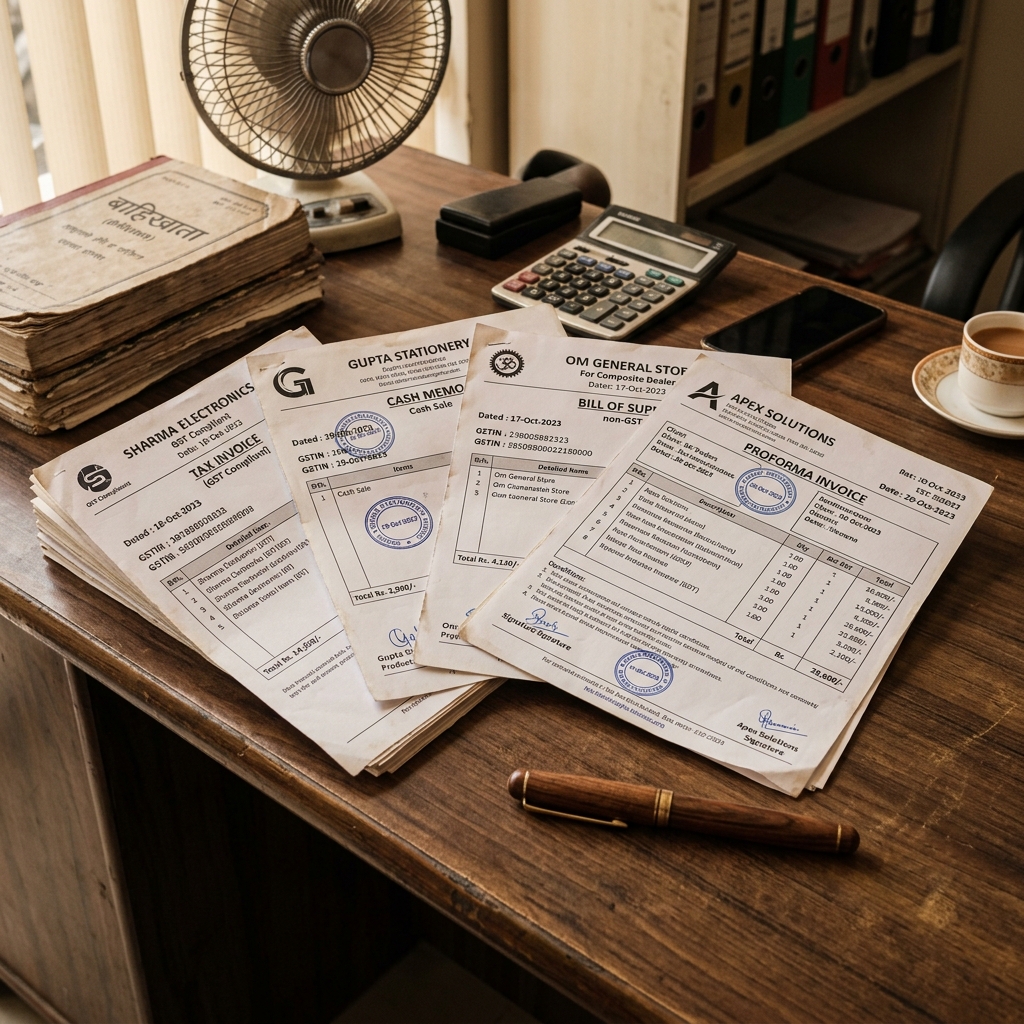
Every small business in India works with seven core types of bills: the tax invoice, bill of supply, proforma invoice, receipt, debit and credit notes, delivery challan, and the e-invoice. Each one does a specific legal job — charging tax, quoting a price, acknowledging payment, correcting an earlier bill, or moving goods. Knowing which to issue keeps you GST-compliant and audit-ready. This guide explains all seven with filled Indian examples.
Quick answer: the 7 bills at a glance
- Tax invoice — the main GST document; charges CGST + SGST or IGST on a taxable sale.
- Bill of supply — issued when no GST is charged (composition dealers, exempt goods).
- Proforma invoice — a pre-sale quote or estimate; not a legal demand for payment.
- Receipt — acknowledges that money has actually been received.
- Debit / credit note — corrects an already-issued invoice (under- or over-billing, returns).
- Delivery challan — moves goods without transferring ownership or charging tax.
- E-invoice — a tax invoice authenticated on the government IRP, mandatory above ₹5 crore turnover.
The 7 bill types compared (and why each matters)
| Bill type | When you issue it | GST shown? | Why it matters |
|---|---|---|---|
| Tax invoice | On every taxable sale by a registered business | Yes Yes | Lets the buyer claim input tax credit; basis for your GSTR-1 |
| Bill of supply | Exempt goods, or by a composition dealer | No No | Stays compliant when GST cannot legally be charged |
| Proforma invoice | Before the deal is confirmed | Partial Indicative | Quotes price/terms so the buyer can approve or arrange funds |
| Receipt / payment voucher | When you receive money | Partial Optional | Proves payment was made; supports reimbursement and accounts |
| Debit / credit note | To correct an earlier invoice | Yes Yes | Legally adjusts tax already reported; avoids GST mismatches |
| Delivery challan | Goods move without a sale (job work, transfer) | No No | Allows lawful transport of goods before invoicing |
| E-invoice | Tax invoice above the turnover threshold | Yes Yes | Government-authenticated; auto-populates returns and e-way bills |
1. Tax invoice — the document that charges GST
The tax invoice is the backbone of business billing in India. A GST-registered seller must issue it on every taxable supply of goods or services. It carries your GSTIN, a unique sequential invoice number, the HSN/SAC code, the taxable value, and the CGST + SGST split (for sales inside your state) or IGST (for inter-state sales).
Get the tax invoice right and the rest follows: your buyer can claim input tax credit, and the same numbers flow straight into your GSTR-1. If you sell restaurant food, professional services or retail goods, this is the bill you issue most. For the full field-by-field breakdown, see our GST bill mandatory-fields checklist, and if numbers trip you up, how to calculate GST on an invoice walks through a worked example.
CGST + SGST vs IGST. Intra-state supply (buyer in the same state) splits tax into CGST + SGST. Inter-state supply uses a single IGST at the same combined rate. The place of supply — not where you sit — decides which applies.
Sample tax invoice (filled example)
Das Stationers & Office Supplies 14 Lindsay Street, Kolkata, West Bengal 700087 · GSTIN: 19AAGCK8899T1Z7 Invoice: INV-2026-00318 · Date: 01 Jun 2026 · Place of supply: West Bengal
| Item | HSN | Qty | Rate (₹) | Amount (₹) |
|---|---|---|---|---|
| A4 Copier Paper (75 GSM ream) | 4802 | 10 | 280.00 | 2,800.00 |
| Spiral Notebooks (200 pg) | 4820 | 24 | 65.00 | 1,560.00 |
| Ball Pens (box of 10) | 9608 | 5 | 90.00 | 450.00 |
| Subtotal | 4,810.00 | |||
| CGST @ 9% | 432.90 | |||
| SGST @ 9% | 432.90 | |||
| Grand Total | 5,675.80 |
Payment: NEFT · Bill to: Arjun Das Associates, GSTIN 19AAGCV2201H1Z2
2. Bill of supply — when you can't charge GST
A bill of supply looks like an invoice but shows no tax. You issue one when GST simply cannot be charged:
- You are registered under the composition scheme (you pay a flat GST out of pocket and can't collect it from customers).
- You supply GST-exempt goods or services (for example, fresh produce or certain education and healthcare services).
It carries most of the same fields as a tax invoice — your details, a serial number, the buyer, the item list — but omits the tax breakup. Composition dealers must also print the line "composition taxable person, not eligible to collect tax on supplies." If your turnover is still below the registration threshold, you may not need GST at all; our guide on billing for an unregistered business covers that situation in full.
3. Proforma invoice — a quote, not a bill
A proforma invoice is sent before a sale is confirmed. It states what you intend to supply, at what price and on what terms — so the buyer can approve the order, arrange a budget or open a letter of credit. Crucially:
- It is not a legal demand for payment.
- It cannot be used to claim input tax credit.
- It is not reported in your GST returns.
Once the buyer says yes, you convert it into a proper tax invoice. Mislabelling a proforma as a tax invoice — or booking revenue against it — is a common bookkeeping error. Our dedicated guide on the proforma invoice format shows a filled sample and the exact wording to use.
Always stamp the document "PROFORMA INVOICE" clearly at the top. A buyer who treats it as a final bill, or a finance team that pays against it without a tax invoice, creates a reconciliation headache for both sides.
4. Receipt — proof that money changed hands
An invoice says "you owe this." A receipt says "this has been paid." The two are different documents, and confusing them is the single most common billing mistake — we untangle it fully in invoice vs. bill vs. receipt.
A receipt acknowledges payment and typically shows the amount received, the date, the mode (cash, UPI, cheque, card), what it was for, and a reference to the original invoice. Receipts matter well beyond your own books: employees need them for expense reimbursement, tenants need rent receipts for HRA claims, and gym, clinic and hotel customers expect a receipt for their records.
Sample payment receipt
Apex Fitness Studio · Salt Lake, Kolkata, West Bengal 700091 · Receipt No: RCPT-2026-0912 Received from: Arjun Das · Date: 01 Jun 2026
| Description | Amount (₹) |
|---|---|
| Annual membership (Jun 2026 – May 2027) | 18,000.00 |
| GST @ 18% | 3,240.00 |
| Total received | 21,240.00 |
Mode: UPI · Against Invoice INV-2026-0451 · Received with thanks.
5. Debit and credit notes — fixing an issued invoice
Once a tax invoice is issued and reported, you can't quietly edit it. To correct it, you raise a debit note or a credit note:
- Credit note — reduces what the customer owes. Issued for sales returns, overcharging, post-sale discounts or deficient supply. It lowers your output GST liability for that period.
- Debit note — increases what the customer owes. Issued when you undercharged or supplied extra. It raises additional GST.
Both must reference the original invoice number and date, and both are reported in your GST returns so the tax adjusts cleanly on both sides. Skipping them — and instead editing or re-issuing the original bill — is what creates GSTR-1 vs GSTR-3B mismatches at filing time. If you sell on credit to many buyers, managing invoices for multiple clients shows how to keep these adjustments traceable.
6. Delivery challan — moving goods without a sale
A delivery challan transports goods when no sale (and therefore no GST) happens at that moment. Typical uses:
- Sending goods for job work (e.g. cloth to a tailor, parts to a fabricator).
- Stock transfer between your own branches or warehouses.
- Goods sent on approval / sale-or-return.
- Supply where the quantity isn't known at dispatch (e.g. liquid gas).
The challan shows the goods, quantity and value but does not charge tax, because ownership hasn't transferred. The tax invoice is raised later, when the sale is actually confirmed. For consignments above the prescribed value, a delivery challan usually travels with an e-way bill.
Sample delivery challan
Das Textiles · Challan No: DC-2026-0177 8 Burrabazar Road, Kolkata, West Bengal 700007 · GSTIN: 19AAGCK8899T1Z7 Date: 01 Jun 2026 · Purpose: Job work (stitching)
| Item | Qty | Value (₹) |
|---|---|---|
| Grey cotton fabric (metres) | 500 | 42,500.00 |
| Total (not a tax invoice) | 42,500.00 |
Sent to: Modern Tailoring Unit, Kolkata · Goods to return after job work.
7. E-invoice — the authenticated tax invoice
An e-invoice isn't a separate kind of bill — it's a tax invoice that has been authenticated on the government's Invoice Registration Portal (IRP). The portal validates your invoice, returns a unique Invoice Reference Number (IRN) and a signed QR code, and the data auto-populates your GST returns and e-way bills.
E-invoicing is mandatory for businesses whose aggregate annual turnover crosses ₹5 crore in any financial year since 2017–18, per CBIC notifications(opens in new tab). Below that, it is optional. So most micro and small businesses still issue ordinary tax invoices — but the threshold has steadily dropped, so it's worth knowing where you stand. When e-invoicing applies, the QR code and IRN must appear on the printed bill.
Legal & compliance essentials (FY 2025–26)
A few India-specific rules tie all seven documents together:
- GSTIN format. A valid GSTIN is 15 characters — 2-digit state code, 10-character PAN, plus 3 check characters (e.g.
19AAGCK8899T1Z7, where19is West Bengal). It must appear on every tax invoice and bill of supply you issue once registered. See the income tax(opens in new tab) and CBIC GST(opens in new tab) portals. - GST rate slabs. Standard slabs are 0%, 5%, 12%, 18% and 28%, set by the GST Council(opens in new tab). Pick the slab by HSN/SAC code — don't guess.
- Registration threshold. GST registration is generally required above ₹40 lakh turnover for goods and ₹20 lakh for services (₹20 lakh / ₹10 lakh in some special-category states). Below this you can bill without GST.
- Composition scheme. Available up to ₹1.5 crore turnover (₹75 lakh in special-category states); these dealers issue a bill of supply, never a tax invoice.
- Invoice numbering. Invoice numbers must be unique and sequential within a financial year — gaps or duplicates break your GSTR-1 trail.
- Retention. Keep invoices, notes and challans for the period prescribed under GST law (generally several years from the relevant return due date).
Record-keeping vs fabrication. Generating a clean invoice, receipt or challan from real transaction data is completely legitimate — that's exactly what every accounting tool does. Fabricating a bill for a sale that never happened, inflating amounts, or back-dating documents to claim ITC or expenses is tax fraud. Keep your bills honest and they'll stand up to any audit.
Create any of these bills in 2 minutes
You don't need accounting software to issue a clean, compliant document. Using our bill & receipt templates:
- Pick the document you need — tax invoice, bill of supply, receipt, proforma or challan.
- Enter your business details once — name, address and GSTIN are saved for next time.
- Add line items with quantity and rate; GST (CGST + SGST or IGST) is calculated automatically.
- Choose the bill type label so the document is correctly titled (e.g. "Proforma Invoice" or "Bill of Supply").
- Download a professional PDF ready to print, email or share on WhatsApp.
Online generator vs Word vs Excel
| What matters across 7 bill types | Online generator | MS Word | Excel / manual |
|---|---|---|---|
| Switch between invoice, bill of supply, receipt & challan | Yes One click changes the title and tax behaviour | No A separate file per type | Partial Copy-paste a different sheet |
| Shows or hides the GST breakup correctly | Yes Auto — drops tax on a bill of supply | Partial Easy to forget on exempt bills | Partial Manual cell editing |
| Keeps one unbroken invoice-number series | Yes Counter never repeats a number | No Type it yourself, gaps happen | Partial Drag-fill, easy to duplicate |
| Links a credit/debit note to its parent invoice | Yes Pulls the original number for you | No Re-key by hand | Partial VLOOKUP if you build it |
| Stamps the right label (Proforma / Bill of Supply) | Yes Picked from a list | Partial Hand-typed heading | Partial Hand-typed heading |
| Re-uses saved business + GSTIN details | Yes Saved once, reused everywhere | No Retype on each document | Partial Reference a master cell |
| Minutes to produce a clean PDF | Yes Around 2 | Partial 10–15 with formatting | Partial 5–10 plus PDF export |
Common mistakes to avoid
- Issuing a tax invoice when you should issue a bill of supply — composition dealers and exempt suppliers cannot legally charge GST.
- Treating a proforma invoice as a final bill — it's a quote; book revenue and claim ITC only against a real tax invoice.
- Editing an issued invoice instead of raising a credit/debit note — this causes GSTR-1 vs GSTR-3B mismatches.
- Moving goods on an invoice when a delivery challan is correct (job work, stock transfer) — or vice versa.
- Reusing or skipping invoice numbers — numbering must be unique and sequential within the financial year.
- Printing an old, invalid or wrongly-formatted GSTIN — buyers can't claim ITC and you risk penalties.
Sources & references
- CBIC GST Portal(opens in new tab) — tax invoice rules, e-invoicing thresholds, bill of supply
- GST Council(opens in new tab) — GST rate slabs and notifications
- Income Tax Department(opens in new tab) — PAN and GSTIN structure
Need to raise any of these seven documents right now? Browse the bill & receipt templates → — pick a type, fill it in, and download a clean PDF in under two minutes. No sign-up required.