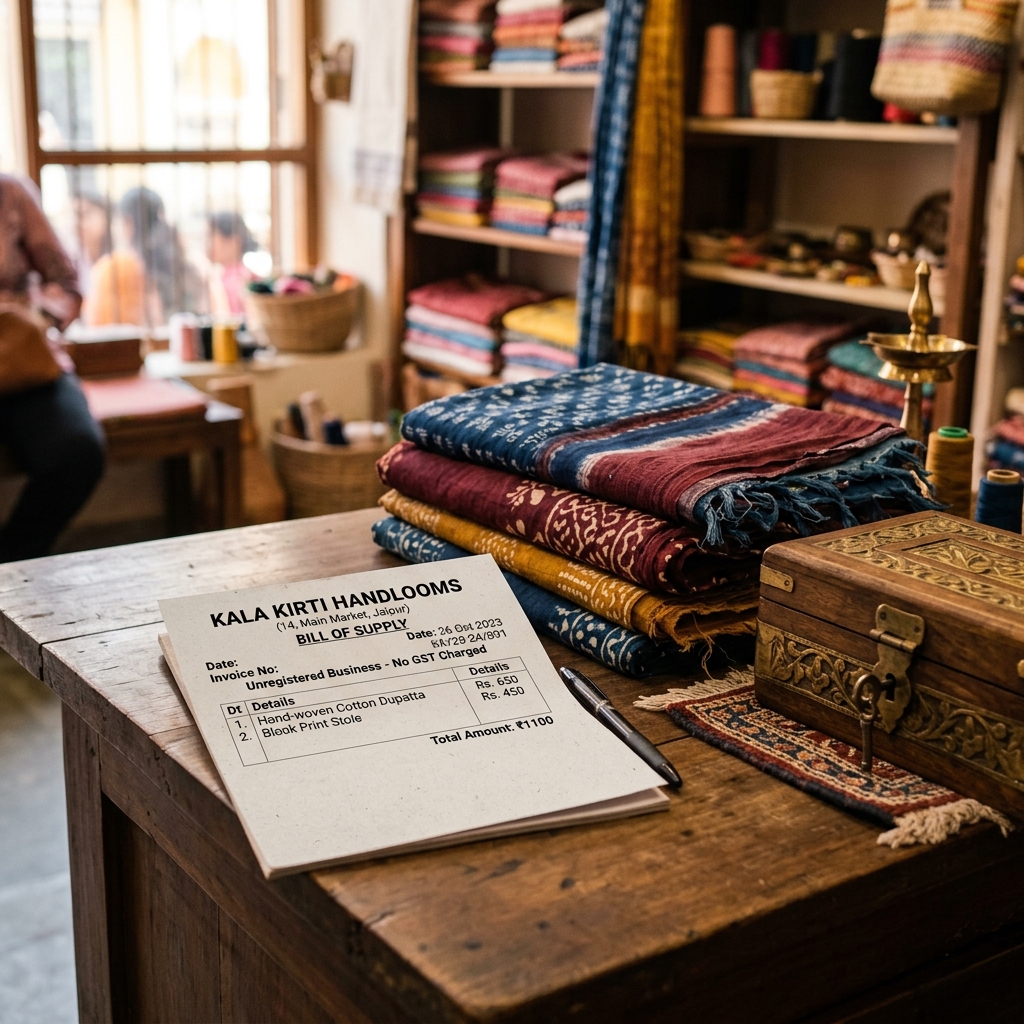
If your business is below the GST registration threshold, you can legally issue a bill without a GSTIN and without charging any GST. This document is called a bill of supply (or simply an invoice). It carries your business name and address, an itemised list, a total — but no CGST, SGST or IGST line. This guide gives you the exact format, a filled sample, and a free way to make one in two minutes.
Quick answer: billing without GST
- You can issue a bill without a GST number if you are under the registration threshold.
- The document is a bill of supply — same as an invoice, minus the GST.
- It must include your business name, address, a unique bill number, the buyer's details, an itemised list, and a total.
- Do not show any amount as CGST, SGST or IGST — collecting GST without a GSTIN is illegal.
- Quoting your PAN is optional but recommended; it helps the buyer and your own records.
- Register for GST once turnover crosses ₹40 lakh (goods) or ₹20 lakh (services) in most states.
Mandatory fields (and why each one matters)
A bill of supply has fewer compulsory fields than a tax invoice, but each one still earns its place.
| Field | Example | Why it matters |
|---|---|---|
| Business name | Agarwal Handicrafts (prop. Anil Agarwal) | Identifies the supplier; required for a valid commercial document |
| Address & contact | 14 Johari Bazaar, Jaipur, Rajasthan 302003 | Establishes who is supplying and where to reach you |
| Bill / serial number | BOS-2026-018 | Must be unique and sequential for clean book-keeping |
| Date of issue | 01 Jun 2026 | Anchors the transaction to a financial year |
| Buyer name & address | Trivedi Interiors, Jaipur (GSTIN 08AADCJ1290Q1Z6) | Needed for the buyer's expense and reimbursement records |
| PAN (recommended) | AGXPA4521K | Helps with TDS, high-value sales and income-tax matching |
| Itemised list | Wooden wall panel × 2 @ ₹1,850 | Transparency; shows exactly what was sold |
| Total amount (₹) | ₹3,700 | The amount actually payable — no tax added |
| Payment mode | UPI / Cash / Bank transfer | Reconciliation and audit trail |
| Signature | Authorised signatory | Confirms the bill is genuine |
Key rule: because you are not registered, there is no GST row. The price you quote is the final price. Adding a "GST" line without a GSTIN turns a legitimate bill into an offence under the CGST Act, 2017(opens in new tab).
Sample bill of supply (filled example)
Agarwal Handicrafts (Proprietor: Anil Agarwal) 14 Johari Bazaar, Jaipur, Rajasthan 302003 · Phone: +91 98290 11223 PAN: AGXPA4521K · Unregistered under GST Bill of Supply No: BOS-2026-018 · Date: 01 Jun 2026 Billed to: Trivedi Interiors, 5 Civil Lines, Jaipur 302006 · GSTIN: 08AADCJ1290Q1Z6
| Item | Qty | Rate (₹) | Amount (₹) |
|---|---|---|---|
| Hand-carved wooden wall panel | 2 | 1,850.00 | 3,700.00 |
| Brass table lamp | 1 | 1,200.00 | 1,200.00 |
| Cotton table runner | 3 | 450.00 | 1,350.00 |
| Total | 6,250.00 |
Amount in words: Six thousand two hundred fifty rupees only. Payment: UPI · No GST charged — supplier not registered under GST. For Agarwal Handicrafts — Authorised Signatory (Anil Agarwal)
Notice there is no CGST/SGST block and no GSTIN. The "No GST charged" note removes any doubt for the buyer and any future auditor.
The legal picture: when you must register (FY 2025–26)
An unregistered business is entirely legitimate — the law simply expects you to register once you cross a turnover limit or trigger a special condition.
GST registration thresholds:
| Supply type | Normal states | Special-category states |
|---|---|---|
| Goods | ₹40 lakh turnover | ₹20 lakh turnover |
| Services | ₹20 lakh turnover | ₹10 lakh turnover |
These limits are set by the GST Council(opens in new tab) and notified by the CBIC(opens in new tab). Special-category states include several North-Eastern and hill states; check the current notification for your exact state, as the list and limits can be revised.
You must register regardless of turnover if you:
- Make inter-state taxable supplies of goods (selling goods across state borders).
- Are liable to pay tax under reverse charge.
- Sell taxable goods/services through certain e-commerce operators.
- Act as a casual taxable person or non-resident taxable person.
Below the threshold and not triggering any of the above, you stay unregistered and bill without GST. You may also choose voluntary registration if your buyers want input tax credit — but then you must charge GST and file returns.
Honesty matters. A bill of supply is a legitimate record-keeping tool, not a way to dodge tax. What is not legal: printing a fake GSTIN, collecting "GST" you never remit, or splitting one business into several to stay under the threshold artificially. Your income from an unregistered business is still taxable income and must be declared in your income tax return(opens in new tab).
If you later register, your billing rules change — you then issue a full tax invoice with GSTIN and the CGST/SGST split. Our GST bill checklist covers exactly what changes, and the invoice vs bill vs receipt guide clears up the terminology.
Create your bill in 2 minutes
You do not need accounting software to issue a clean bill of supply. Using the bill & invoice generator:
- Pick a simple bill template — no GST fields cluttering the layout.
- Enter your business details — name, address, phone, and PAN (saved for next time).
- Add the buyer's details so the bill is a complete commercial record.
- List your items with quantity and rate; the tool totals them automatically.
- Add a "No GST charged" note and your payment mode.
- Download a professional PDF to print or send on WhatsApp or email.
Because freelancers and tiny shops issue these constantly, it is worth saving a reusable template — our guides on billing as a freelancer and creating a professional bill without software go deeper on that workflow.
Online generator vs Word vs Excel
| What matters for a bill of supply | Online generator | MS Word | Excel / manual |
|---|---|---|---|
| GST-free layout (no CGST/SGST rows to delete) | Yes Built in | Partial Strip by hand | Partial Strip by hand |
| "No GST charged" note pre-filled | Yes | No | No |
| Auto-totals items without a tax column | Yes | No Manual | Partial Formula needed |
| Keeps bill numbers unique & sequential | Yes Tracked | No | Partial You watch it |
| Saved PAN & shop details for repeat bills | Yes | Partial Re-type | Partial Re-type |
| Clean PDF for WhatsApp / email | Yes | Partial Export needed | No |
| Stays tidy as turnover nears the threshold | Yes Easy to export | Partial Scattered files | Partial Scattered sheets |
Common mistakes to avoid
- Adding a GST line without a GSTIN. This is the single biggest error — and an offence. No registration means no GST on the bill.
- Printing a borrowed or fake GSTIN to look "official." It exposes you to heavy penalties and invalidates the bill.
- Skipping or repeating bill numbers. Keep them unique and sequential so your books and ITR reconcile cleanly.
- Forgetting the buyer's details. Without them the bill is weak as a reimbursement or expense record.
- Not declaring the income. Unregistered for GST still means fully taxable for income tax — keep every bill for your return.
- Ignoring the threshold. Track turnover monthly; crossing ₹40 lakh (goods) or ₹20 lakh (services) makes registration mandatory, not optional.
Sources & references
- CBIC GST Portal(opens in new tab) — registration thresholds and bill-of-supply rules
- GST Council(opens in new tab) — threshold and rate notifications
- Income Tax Department(opens in new tab) — income declaration and PAN
- India Code — CGST Act, 2017(opens in new tab) — registration and tax-collection provisions
Below the GST threshold and need a clean bill today? Create a bill free → — no GST clutter, no sign-up, instant PDF.