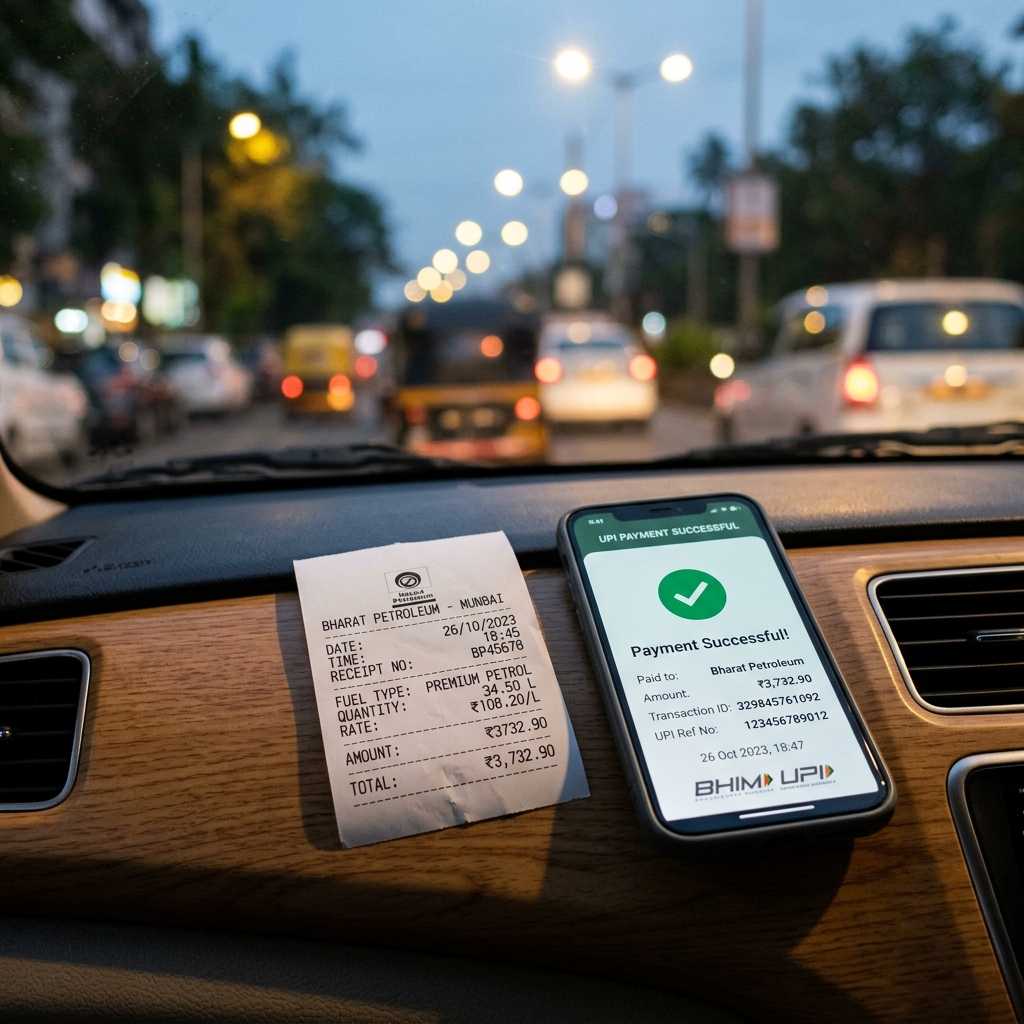
Yes — you can legally create your own fuel bill as a record of fuel you actually purchased, for your books, mileage logs or to support a reimbursement claim. What is not legal is fabricating a fuel pump receipt for fuel you never bought, or inflating the amount. That crosses from honest record-keeping into invoice fraud. This guide draws the line clearly and shows you the right way to do it.
Quick answer: legal vs illegal
- Yes Legal — making a fuel expense voucher or record for a genuine purchase you made
- Yes Legal — recreating a record when the original receipt is lost, if the purchase was real
- Yes Legal — using a generator to format your own fuel log for personal tracking
- No Illegal — fabricating a pump receipt for fuel you never bought
- No Illegal — inflating litres or amount to claim more reimbursement or tax benefit
- No Illegal — forging a fuel station's name, logo or details to fake third-party proof
The honest rule of thumb: a self-made fuel bill can document a real transaction. It can never invent one. If money or a tax benefit changes hands on the strength of a number you made up, it is fraud.
What counts as legitimate record-keeping
A self-generated fuel bill is fine when it is an internal record, not a forged third-party document. Genuine uses include:
| Use case | Why it's legitimate | What proof you still keep |
|---|---|---|
| Personal mileage / fuel log | It's your own tracking record, no claim attached | Original pump receipts, ideally |
| Expense voucher for a real purchase | Documents a genuine business cost in your books | The actual pump-printed or digital receipt |
| Reimbursement support sheet | Summarises real fuel spends for your employer | The underlying station receipts |
| Reconstructing a lost receipt | The purchase was real; you're rebuilding the record | Card/UPI statement showing the payment |
| Fleet fuel tracking | Internal control over vehicle-wise consumption | Station invoices per fill |
In every legitimate case, the self-made bill sits on top of a real purchase. The third-party proof — the pump receipt, the card statement, the app invoice — is what actually validates it. For fleet operators, pairing self-made logs with station receipts is standard practice; see our guide on diesel bill records for fleet management.
Fields a genuine fuel record should carry
| Field | Example | Why it matters |
|---|---|---|
| Fuel station name | Indian Oil — Sabarmati Auto Fuels | Identifies where the real purchase happened |
| Station address | SG Highway, Bodakdev, Ahmedabad 380054 | Place of supply; matches the actual outlet |
| Invoice / receipt number | IOC-2026-08841 | Ties the record to the original receipt |
| Date & time | 01 Jun 2026, 9:15 AM | Required for the expense period |
| Vehicle number | GJ 01 AB 4567 | Links the fuel to a specific vehicle |
| Fuel type | Petrol / Diesel / CNG | Determines tax treatment |
| Litres & rate | 28.50 L @ ₹104.20 | Basis of the amount; must match reality |
| Amount paid | ₹2,969.70 | The actual money spent |
| Payment mode | UPI / Card / Cash | Reconciles against your bank record |
Sample fuel record (filled example)
Indian Oil — Sabarmati Auto Fuels SG Highway, Bodakdev, Ahmedabad, Gujarat 380054 GSTIN: 24AAACA7788N1Z4 Receipt: IOC-2026-08841 · Date: 01 Jun 2026, 9:15 AM Vehicle: GJ 01 AB 4567 · Customer: Mehul Patel
| Detail | Value |
|---|---|
| Fuel type | Petrol |
| Rate per litre | ₹104.20 |
| Quantity | 28.50 L |
| Amount | ₹2,969.70 |
| Payment mode | UPI |
| Total paid | ₹2,969.70 |
Note: petrol/diesel prices are all-inclusive of excise and state VAT — no separate GST line appears.
This is a clean, professional record of a real fill. The litres, rate and amount all match what was actually paid. That is exactly the kind of document a fuel bill generator is built to produce — not a forgery, but a tidy version of a genuine transaction.
The legal and tax position (FY 2025–26)
A few India-specific facts decide what is allowed:
1. Petrol and diesel are outside GST. They are taxed under central excise duty plus state VAT, not CGST/SGST. So a genuine petrol/diesel pump receipt shows an all-inclusive price and no GST split. A "fuel bill" that invents a CGST/SGST breakup on petrol is an immediate red flag of a fake. (CNG, EV charging and lubricants do attract GST — see CBIC GST(opens in new tab), and our notes on the CNG bill format and the EV charging bill format where a real GST split is expected.)
2. A self-made bill is not third-party proof. Under the Income-tax framework, a business expense must be genuine and supported by credible evidence (incometax.gov.in(opens in new tab)). An internal voucher can support a claim, but if there is no real underlying purchase, the expense can be disallowed and the deduction reversed.
3. Fabrication is an offence. Creating false documents to obtain money or a tax benefit attracts penalties for misreporting/under-reporting of income under the Income-tax Act, and can amount to forgery and cheating under the Bharatiya Nyaya Sanhita(opens in new tab) (which replaced the IPC). The provisions on false documents are not theoretical — they apply to fake bills.
4. Employer policy is binding too. Even where the law is silent on a small reimbursement, submitting a fabricated bill breaches your employment terms and can lead to recovery and termination, independent of any tax issue.
Bottom line: the format of a fuel bill is never the problem. The truth of the numbers inside it is. Keep the numbers real and you are on solid ground.
How to create a genuine fuel record in 2 minutes
For a real purchase where you want a clean, presentable record, use the fuel bill generator:
- Pick the fuel bill template — it lays out station, vehicle and fuel fields.
- Enter the actual station details from your original receipt — never invent a station.
- Fill in the real litres, rate and amount exactly as paid.
- Add the vehicle number and date so the record is traceable.
- Download a clean PDF and keep the original pump receipt with it.
If the record is for an expense claim, read how to claim fuel reimbursement from your employer first so you submit it the way your policy expects, and check the accepted petrol bill format for reimbursement.
Generator vs Word vs manual
| Online generator | MS Word | Excel / manual | |
|---|---|---|---|
| Resembles a real pump receipt | Yes Pump-style layout | No Looks like a letter | No Looks like a sheet |
| Auto rate × litres → amount | Yes Calculated | No Type it yourself | Partial Needs a formula |
| Suppresses the GST line on petrol/diesel | Yes Built in | Partial Easy to add by mistake | Partial Easy to add by mistake |
| Per-vehicle record fields (reg. no.) | Yes Prefilled | No Manual | No Manual |
| Receipt-number sequencing | Yes Guided | No Track it yourself | Partial Manual column |
| Speed per fill-up record | Yes ~2 min | Partial 10–15 min | Partial 5–10 min |
A generator only formats what you type. It does not — and should not — replace the original station receipt for any claim.
Common mistakes to avoid
- Fabricating a receipt for fuel you never bought — this is fraud, full stop.
- Inflating litres or the amount to claim more than you spent.
- Inventing a CGST/SGST split on petrol or diesel — those fuels are outside GST; it exposes the bill as fake.
- Copying a fuel station's logo or details to pass a self-made bill off as theirs.
- Discarding the original pump receipt and relying only on a self-made one for a claim.
- Mismatching the bill against your card/UPI statement — the amounts must reconcile.
Sources & references
- CBIC GST Portal(opens in new tab) — GST scope; petrol/diesel are outside GST, CNG and lubricants within it
- Income Tax Department(opens in new tab) — genuineness of expenses and penalties for misreporting
- India Code(opens in new tab) — Bharatiya Nyaya Sanhita provisions on false documents and cheating
Have a genuine fuel purchase to document? Create a clean fuel bill free → — keep your original receipt, format the record honestly, done in two minutes.