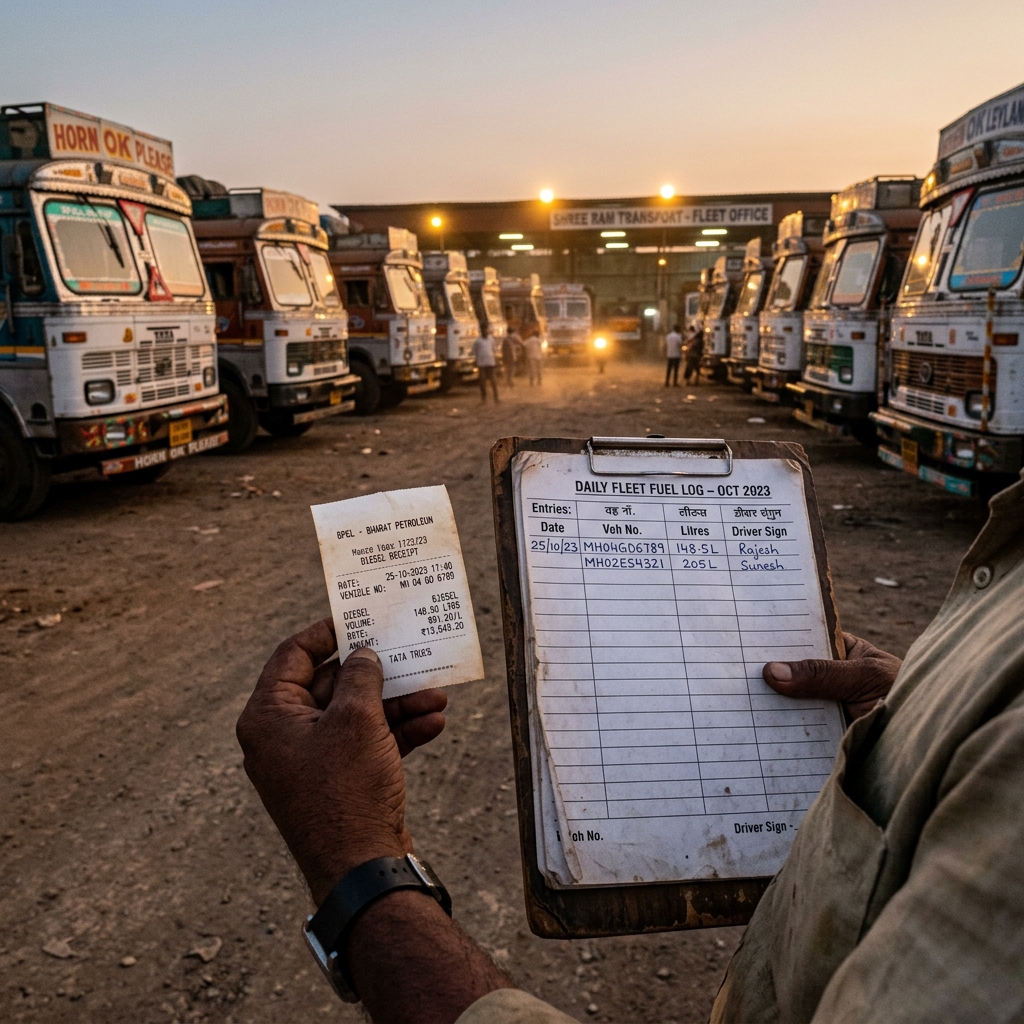
A diesel bill for fleet records must show the pump name, address and GSTIN, an invoice number and date, the vehicle registration number and odometer reading, and the litres, rate per litre and total paid. Note that diesel sits outside GST — the price already includes excise and VAT — so there is no CGST/SGST line. Get the vehicle number and odometer right and the bill becomes a usable fleet-tracking record.
Quick answer: what a fleet diesel bill must include
- Fuel station (dealer) name, address, and contact
- GSTIN of the pump (15 digits) if registered
- Unique invoice/receipt number and date/time
- Vehicle registration number (e.g. MH12 AB 1234)
- Odometer reading at fill-up (km)
- Diesel quantity in litres and rate per litre
- Total amount paid and payment mode
- No GST line — diesel is outside GST
Mandatory fields (and why each one matters)
| Field | Example | Why it matters |
|---|---|---|
| Fuel station name | Indian Oil — Iyer Highway Fuels | Identifies the dealer; expected on any genuine receipt |
| Address | Western Express Highway, Andheri East, Mumbai, Maharashtra 400069 | Establishes where the fuel was bought |
| GSTIN | 27AAJCM4521P1Z3 | Confirms a registered dealer (note: diesel itself carries no GST) |
| Invoice number | DSL-2026-04417 | Unique reference for audit and reconciliation |
| Date & time | 01 Jun 2026, 9:15 AM | Ties the fill-up to a trip and tax period |
| Vehicle number | MH12 AB 1234 | The single most important field for vehicle-wise tracking |
| Odometer reading | 84,620 km | Lets you compute mileage and cost per km |
| Quantity (litres) | 42.50 L | Basis for cost and consumption analysis |
| Rate per litre | ₹94.20 | Locks the price; varies by state and date |
| Total amount | ₹4,003.50 | The amount actually paid |
| Payment mode | Fleet card / UPI / Cash | Reconciliation and fraud control |
Sample diesel bill (filled example)
Indian Oil — Iyer Highway Fuels (Proprietor: Suresh Iyer) Western Express Highway, Andheri East, Mumbai, Maharashtra 400069 · GSTIN: 27AAJCM4521P1Z3 Receipt: DSL-2026-04417 · Date: 01 Jun 2026, 9:15 AM Vehicle: MH12 AB 1234 · Driver: Ramesh Patil · Odometer: 84,620 km
| Description | Quantity | Rate (₹/L) | Amount (₹) |
|---|---|---|---|
| High-Speed Diesel (HSD) | 42.50 L | 94.20 | 4,003.50 |
| Total payable | 4,003.50 |
Payment: Fleet card · GST: Not applicable (diesel is outside GST)
Fleet note: Previous odometer 84,120 km → 500 km on the last 41.0 L tank = 12.2 km/L. Logging this per fill-up is how fuel theft and engine issues get caught early.
Why a diesel bill has no GST (the part most people get wrong)
This is the non-obvious fact that trips up fleet teams: petrol and diesel are outside the GST regime in India. They are listed as goods on which GST is not yet levied, so they continue under the older tax structure:
- Central excise duty — charged by the Union government, built into the rate.
- State VAT (and any cess) — charged by each state, which is why diesel costs differ from Maharashtra to Karnataka.
Both taxes are already inside the per-litre price you pay — they are not shown as separate lines, and there is no CGST or SGST on a diesel receipt. The practical consequences for a company:
- No GST input tax credit is available on diesel. There is no GST component to reclaim, so the full diesel cost is booked as a business expense. (Contrast this with a CNG bill, which follows the same outside-GST logic, and with a regular GST tax invoice, where CGST/SGST is mandatory.)
- A GSTIN on the receipt confirms the dealer is registered, but it does not mean GST was charged on the fuel.
- Bringing petrol/diesel under GST requires a GST Council(opens in new tab) decision; until that happens, the excise-plus-VAT structure stands. See the CBIC GST portal(opens in new tab) for the goods currently outside GST.
Legitimate vs fraudulent. Keeping your own diesel logs and re-creating a clean copy of a real purchase for your records is normal fleet practice. Manufacturing a pump receipt for fuel that was never bought — to inflate expenses or pad a reimbursement — is fraud and can attract penalties under the Income Tax Act(opens in new tab). The fields in this guide exist to document genuine spend, not to fabricate it.
For a fuller treatment of where the line sits, see our guide on whether you can create your own fuel bill.
How to create a fleet diesel bill in 2 minutes
For a single record you don't need accounting software. Using the fuel bill generator:
- Pick the diesel/fuel template that already drops the GST line and adds vehicle fields.
- Enter the pump details — name, address, GSTIN (saved for next time).
- Add the vehicle number and odometer reading for this fill-up.
- Enter litres and rate per litre — the tool computes the total; no GST is added.
- Set the payment mode (fleet card, UPI, cash) and download a clean PDF for your records.
Repeat per vehicle and you have an auditable, per-vehicle fuel trail. For the full system around this, read how fleet managers track fuel expenses. If a driver is paying out of pocket and recovering it later, the same record doubles as backup when you claim fuel reimbursement from an employer.
Online generator vs Word vs Excel/manual
| What matters for a diesel bill | Online generator | MS Word | Excel / manual |
|---|---|---|---|
| Keeps the receipt GST-free by default | Yes No GST line ever appears | No A stray CGST/SGST row creeps in | Partial Depends on your template discipline |
| Reads like a genuine pump slip | Yes HSD layout, rate × litres shown | Partial Needs hand-formatting | No Looks like a spreadsheet, not a slip |
| Captures vehicle reg + odometer | Yes Dedicated fields | Partial Add the rows yourself | Partial Set up the columns first |
| Computes litres × rate per litre | Yes Auto-totals as you type | No Type the maths in | Partial Only if the formula is right |
| Sequential, unique receipt numbers | Yes Auto-incremented | No You remember the last one | Partial Risk of duplicate refs |
| Rolls up cost per vehicle / km | Partial Export then analyse | No Not built for it | Yes Pivot tables shine here |
| Clean, print-ready PDF per fill-up | Yes One-click | Partial Export quality varies | No Awkward to print |
Many fleets pair a generator (for clean per-fill receipts) with one Excel master sheet (for cross-vehicle analysis). They complement each other.
Common mistakes to avoid
- Adding a CGST/SGST line to a diesel bill — diesel is outside GST; any GST shown is wrong.
- Trying to claim input tax credit on diesel — there is no GST to claim.
- Skipping the vehicle number or odometer — without these the bill is useless for fleet tracking and mileage analysis.
- Reusing or skipping receipt numbers — breaks your audit trail and invites scrutiny.
- Using one date for a batch of fills — each fill-up needs its own date/time and odometer.
- Fabricating receipts for fuel never purchased — that is fraud, not record-keeping.
Sources & references
- GST Council(opens in new tab) — petrol/diesel remain outside GST until a Council decision
- CBIC GST Portal(opens in new tab) — goods currently outside the GST regime, tax invoice rules
- Income Tax Department(opens in new tab) — expense substantiation and consequences of false records
- India Code(opens in new tab) — central excise and allied legislation
Need a clean, GST-free diesel record per vehicle? Create a fuel bill free → — add vehicle number and odometer, instant PDF, no sign-up.