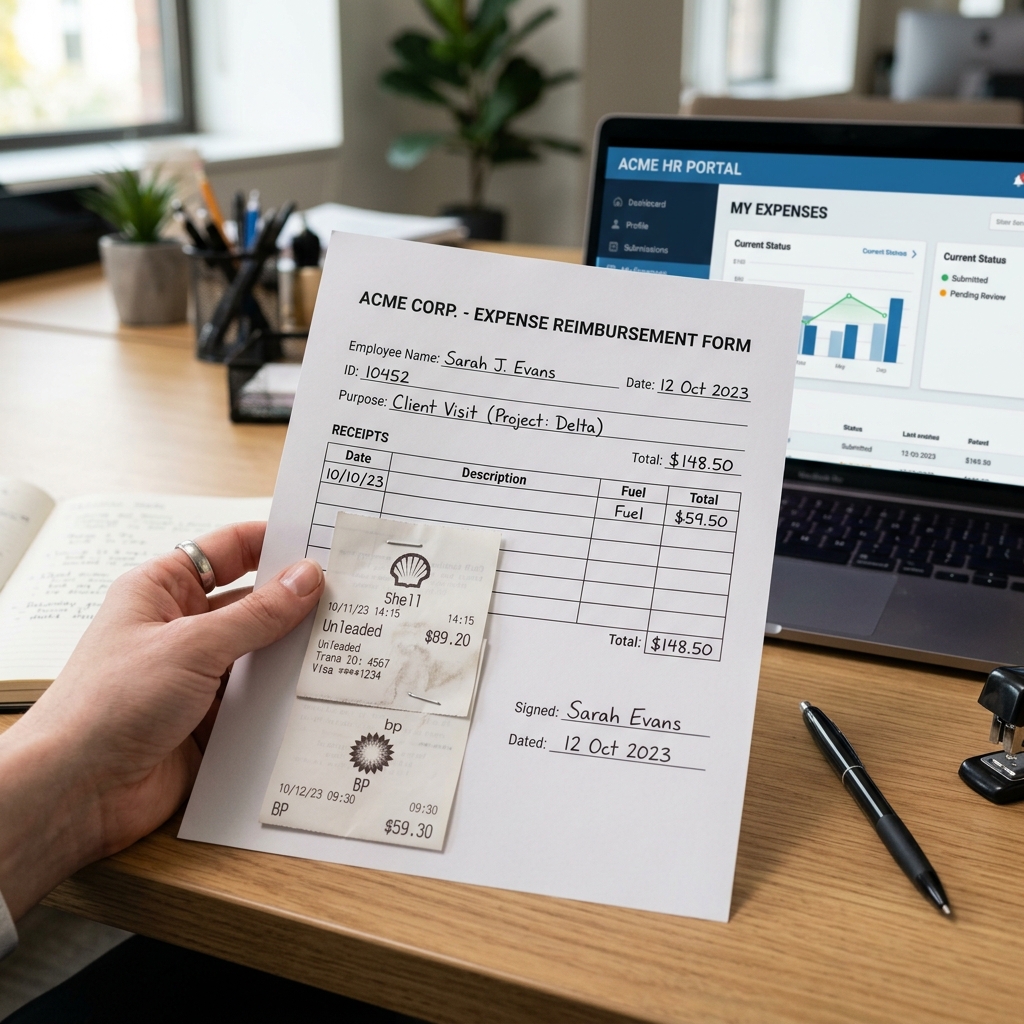
To claim fuel reimbursement in India, submit your original fuel bills along with your employer's expense claim form within the deadline set by company policy. The bill must show the pump name, date, fuel quantity, rate and amount; many employers also want a logbook of business kilometres. Reimbursement of fuel used for official duty, backed by bills, is usually tax-free.
Quick answer: how to claim fuel reimbursement
- Collect original petrol/diesel/CNG receipts for every official trip
- Fill your employer's fuel reimbursement / expense claim form
- Attach a logbook or trip sheet if your policy requires kilometre records
- Submit before the monthly/quarterly cut-off date
- Keep copies of every bill for your own tax records
- Expect tax-free treatment when fuel is for official use and bill-supported
Mandatory fields on a fuel bill (and why each matters)
| Field | Example | Why it matters |
|---|---|---|
| Fuel station name | Indian Oil – Sai Service Station | Identifies a genuine, traceable vendor |
| Station address | Anna Salai, Guindy, Chennai 600032 | Confirms the location of the purchase |
| Bill / receipt number | RCP-2026-08841 | Makes the claim unique and auditable |
| Date & time | 27 May 2026, 9:14 AM | Must fall within the claim period |
| Fuel type | Petrol / Diesel / CNG | Determines tax treatment and policy slab |
| Quantity (litres/kg) | 18.42 L | Basis for verifying the amount and mileage |
| Rate per litre/kg | ₹104.30 | Lets finance cross-check the prevailing price |
| Total amount | ₹1,921.00 | The figure actually reimbursed |
| Vehicle number | TN 09 BX 4471 | Links the spend to the right vehicle |
| Payment mode | UPI / Card / Cash | Helps reconcile against bank records |
Sample fuel bill (filled example)
Indian Oil – Sai Service Station Anna Salai, Guindy, Chennai, Tamil Nadu 600032 · Dealer GSTIN: 33AABCT5567M1Z9 Receipt: RCP-2026-08841 · Date: 27 May 2026, 9:14 AM
| Detail | Value |
|---|---|
| Customer | Lakshmi Narayan |
| Vehicle number | TN 09 BX 4471 |
| Fuel type | Petrol (XtraPremium) |
| Quantity | 18.42 L |
| Rate per litre | ₹104.30 |
| Total amount | ₹1,921.00 |
| Payment mode | UPI |
Note: petrol and diesel are outside GST, so the receipt shows no CGST/SGST line. The dealer GSTIN appears because the station also sells GST-taxable items like lubricants and snacks.
Tax treatment of fuel reimbursement (FY 2025–26)
This is where most employees get confused. The tax outcome depends on who owns the vehicle and whether bills support the claim:
- Actual reimbursement, official use, with bills — Fuel used wholly for the employer's business and reimbursed against bills is a business expense, not income. It is generally not taxable in your hands.
- Fixed fuel allowance, no bills — A flat monthly "fuel allowance" paid regardless of actual spend is treated as salary and is fully taxable.
- Car used partly for personal use (employer-owned or reimbursed) — The personal portion is a perquisite. The Income Tax Rules value it using fixed monthly figures—broadly ₹1,800 per month for cars up to 1,600cc and ₹2,400 per month above 1,600cc (plus ₹900 per month if a driver is provided). These are valuation amounts under Rule 3, not a cap on what you can be reimbursed.
Principle over guesswork: the exact slab and any cap come from your company policy and your salary structure. For the official perquisite valuation method, see the Income Tax Rules on the Income Tax Department portal(opens in new tab). Confirm your specific case with your payroll team.
A crucial fact worth flagging: petrol, diesel and natural gas are currently outside the GST regime. They are taxed through central excise and state VAT, not CGST/SGST. So unlike a restaurant bill with GST, a fuel receipt for petrol or diesel will not carry a tax split—a point reimbursement teams sometimes wrongly query. The latest position is confirmed by the GST Council(opens in new tab) and CBIC(opens in new tab).
If you are unsure whether to log a petrol or diesel record, our dedicated guides on the petrol bill format for reimbursement and the diesel bill format for fleet records walk through each field.
How to create a fuel bill in 2 minutes
Always keep the original receipt from the pump—that is your primary evidence. But thermal-paper receipts fade fast, and a faint, unreadable bill gets rejected. If you have a genuine purchase to document and the printed slip is illegible or lost, you can produce a clean, accurate record of that actual purchase with the fuel bill generator:
- Choose a fuel bill template laid out with the standard pump fields.
- Enter the real station details — name, address and location.
- Fill the actual purchase data — date, fuel type, litres, rate and total exactly as they occurred.
- Add your vehicle number and payment mode for a complete claim record.
- Download a tidy PDF ready to attach to your expense form.
Honesty matters. Recreating a legible copy of a real purchase is legitimate record-keeping. Fabricating a fuel bill for fuel you never bought is expense fraud—it can mean termination and tax penalties. We draw the line clearly in Can you create your own fuel bill? What's legal.
Online generator vs Word vs manual
| Online generator | MS Word | Excel / manual | |
|---|---|---|---|
| Looks like a real pump slip | Yes Pump-style layout | Partial Needs manual design | No Grid, not a receipt |
| Auto rate × litres = total | Yes Calculated live | No Typed by hand | Partial Only if you build the formula |
| No accidental GST line on petrol/diesel | Yes Handled correctly | Partial Easy to add by mistake | Partial Easy to add by mistake |
| Vehicle-number & trip field | Yes Built-in slot | Partial Add manually | Partial Add a column |
| Per-vehicle / repeat-trip records | Yes Details saved | No Retype each time | Partial Copy-paste rows |
| Faded-slip recreation in minutes | Yes ~2 min | Partial 10–15 min | Partial 5–10 min |
| Audit-ready PDF for finance | Yes Clean export | Partial Manual export | No Print/convert yourself |
Common mistakes to avoid
- Submitting faded or torn receipts — finance rejects anything unreadable; keep a clean PDF copy.
- Missing the claim deadline — most policies have a monthly or quarterly cut-off; late bills lapse.
- No vehicle number on the bill — without it, finance can't tie the spend to your car.
- Mixing personal and official fuel — claim only official-use litres, or the personal share becomes a taxable perquisite. If you run several vehicles, a tidy fleet fuel expense tracking habit keeps each claim separable.
- Expecting a GST split on petrol/diesel — there isn't one; these fuels are outside GST.
- Fabricating bills to inflate the claim — this is fraud, not record-keeping, and carries serious consequences.
Sources & references
- Income Tax Department of India(opens in new tab) — perquisite valuation rules and salary taxation
- GST Council(opens in new tab) — status of petroleum products under GST
- CBIC GST Portal(opens in new tab) — indirect-tax treatment of fuels
- India Code(opens in new tab) — Income-tax Act and Rules
Need a clean, accurate fuel record for your next claim? Create a fuel bill free → — no sign-up, instant PDF.