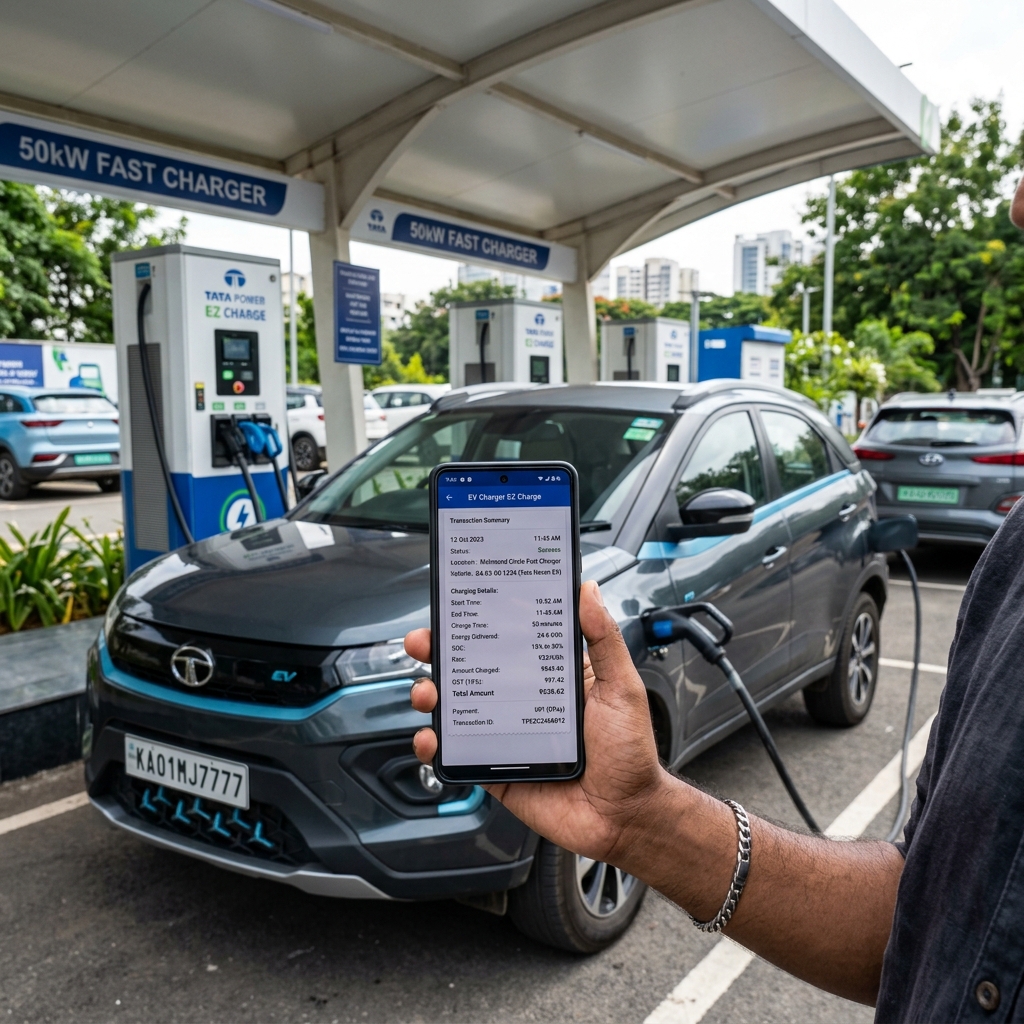
An EV charging bill in India must show the charging station or CPO name, address and GSTIN, the energy consumed in kWh, the tariff per kWh, the 18% GST split (CGST + SGST), and the final total. Get those right and the receipt is valid for your own records, for expense reimbursement, and for GST input credit if you are a business. This guide gives you the exact format, a filled sample, and a free way to make one in two minutes.
Quick answer: what an EV charging bill must include
- Charging station / CPO (Charge Point Operator) name and address
- GSTIN (15 digits) of the operator
- Unique, sequential invoice number and date/time
- Charger ID or connector type (CCS2, Type 2, GB/T)
- Energy consumed in kWh and tariff per kWh
- Optional service, parking, or idle-fee line
- CGST + SGST @ 9% each (18% total)
- Grand total and payment mode (UPI / card / app wallet)
Mandatory fields (and why each one matters)
| Field | Example | Why it matters |
|---|---|---|
| Station / CPO name | Tata Power EZ Charge — Koramangala | Identifies the legal supplier on the tax invoice |
| Address | 80 Feet Road, Koramangala, Bengaluru 560095 | Establishes place of supply for GST |
| GSTIN | 29AAGCB3344L1Z2 | Mandatory for the registered operator; lets a business claim input tax credit |
| Invoice number | EVC-2026-008842 | Must be unique and sequential for the operator's GSTR-1 |
| Date & time | 01 Jun 2026, 6:18 PM | Fixes the tax period and supports a reimbursement timeline |
| Charger / connector | DC Fast · CCS2 · Charger #04 | Confirms the session and rate band charged |
| Energy (kWh) | 24.50 kWh | The core quantity billed; basis for the tariff |
| Tariff per kWh | ₹21.00 / kWh | Transparency; lets you verify the energy charge |
| CGST & SGST | 9% + 9% | The legally required 18% tax split for intra-state supply |
| Grand total | ₹607.10 | The amount actually payable |
| Payment mode | UPI / App wallet / Card | Record-keeping and reconciliation |
Sample EV charging bill (filled example)
Tata Power EZ Charge — Koramangala Hub 80 Feet Road, Koramangala, Bengaluru, Karnataka 560095 · GSTIN: 29AAGCB3344L1Z2 Invoice: EVC-2026-008842 · Date: 01 Jun 2026, 6:18 PM Charger: DC Fast · CCS2 · Charger #04 · Vehicle: KA-01-AB-4521 · Customer: Kiran Rao
| Description | Qty | Rate (₹) | Amount (₹) |
|---|---|---|---|
| Energy delivered (kWh) | 24.50 | 21.00 | 514.50 |
| Service / convenience fee | 1 | 0.00 | 0.00 |
| Subtotal | 514.50 | ||
| CGST @ 9% | 46.30 | ||
| SGST @ 9% | 46.30 | ||
| Grand Total | 607.10 |
Session: 5:51 PM–6:18 PM (27 min) · Payment: UPI · Thank you for charging green!
GST and compliance for EV charging (FY 2025–26)
This is the part most people get wrong, so it is worth being precise:
- Electricity by itself is exempt from GST. Supply of electrical energy is listed as exempt, which is why your home DISCOM bill carries no GST.
- But public EV charging is a service, not a sale of electricity. The CBIC clarified in Circular No. 235/29/2024-GST(opens in new tab) that charging an electric vehicle at a public station is a composite supply of "charging service", and the whole amount is taxable at 18% GST (9% CGST + 9% SGST) for an intra-state session.
- CGST + SGST apply when the station and the customer are in the same state (almost always the case). IGST @ 18% would apply only in the rare inter-state supply scenario.
- Input tax credit (ITC). A GST-registered business charging its own commercial EVs can generally claim the 18% as ITC, provided the GSTIN on the invoice is correct and the bill is reported by the operator in GSTR-1.
- Home charging gives no GST invoice. Energy drawn at home is metered as domestic electricity by your DISCOM and stays GST-exempt — so there is no tax invoice to claim. Only public or commercial stations issue a GST charging bill.
Legitimate records vs fabrication. Keeping or regenerating a clean copy of a charging receipt you actually paid for is perfectly legitimate. Inventing kWh figures or a fake station GSTIN to inflate a reimbursement claim is fraud and can attract penalties under the GST and income-tax laws. Always bill the real session.
For the broader rules on what any tax invoice must carry, see our GST bill mandatory-fields checklist, and if you want to see the CGST/SGST maths worked out, read how to calculate GST on your bill. Rates and circulars above follow official CBIC GST(opens in new tab) notifications; always confirm the current position, as the GST Council can revise it.
How to create an EV charging bill in 2 minutes
You do not need accounting software for a single receipt. Using the fuel bill generator, which handles energy and fuel receipts alike:
- Pick a fuel/energy template that lays out the quantity, rate, and GST fields.
- Enter the station details — CPO name, address, and GSTIN (saved for next time).
- Add the charging line — energy in kWh and the tariff per kWh; the tool computes the amount and the 18% CGST + SGST automatically.
- Set the date, charger ID, and payment mode for a complete, audit-ready record.
- Download a clean PDF ready to attach to a reimbursement claim or save for your books.
This is the same workflow our petrol reimbursement guide uses — only the unit changes from litres to kWh. Drivers of a CNG vehicle follow an identical pattern, and once you have the receipt you can fold it into a wider employer fuel-reimbursement claim alongside your other running costs.
Online generator vs Word vs Excel
| Capability | Online generator | MS Word | Excel |
|---|---|---|---|
| Looks like a real CPO station receipt | Yes Built-in layout | No You design it | No Grid-like, not a receipt |
| Auto kWh × tariff energy charge | Yes Computed live | No Typed by hand | Partial Needs a formula |
| 18% CGST + SGST split applied for you | Yes Automatic | No Manual maths | Partial Cells must be wired up |
| Captures charger ID, connector & session time | Yes Dedicated fields | Partial Free text only | Partial Extra columns |
| Per-vehicle / per-session record history | Yes Saved & reusable | No One-off file | Partial Manual rows |
| Sequential invoice numbering for GSTR-1 | Yes Auto-increment | No Easy to repeat | Partial Manual tracking |
| Export to clean, claim-ready PDF | Yes One click | Partial Save-as PDF | No Awkward print |
Common mistakes to avoid
- Charging 0% GST on a public charging receipt — public EV charging is a taxable service at 18%, not exempt electricity.
- Confusing the units — bill in kWh, never litres; a tariff shown per litre is an instant red flag on an EV claim.
- Printing the wrong GSTIN — a business cannot claim ITC if the operator's 15-digit GSTIN is missing or invalid.
- Repeating or skipping invoice numbers — breaks the operator's GSTR-1 trail and looks fabricated.
- Mixing home and public charging — home charging carries no GST invoice, so do not attach a "GST bill" for energy drawn at home.
- Omitting date, charger ID, or vehicle number — reimbursement teams often require these to match the session to the trip.
Sources & references
- CBIC GST Portal(opens in new tab) — Circular 235/29/2024-GST on EV charging as a service; GST rate and tax-invoice rules
- GST Council(opens in new tab) — rate change notifications
- Income Tax Department(opens in new tab) — record-keeping rules for expense and reimbursement claims
Ready to issue a clean charging receipt right now? Create an EV charging bill free → — no sign-up, instant PDF.