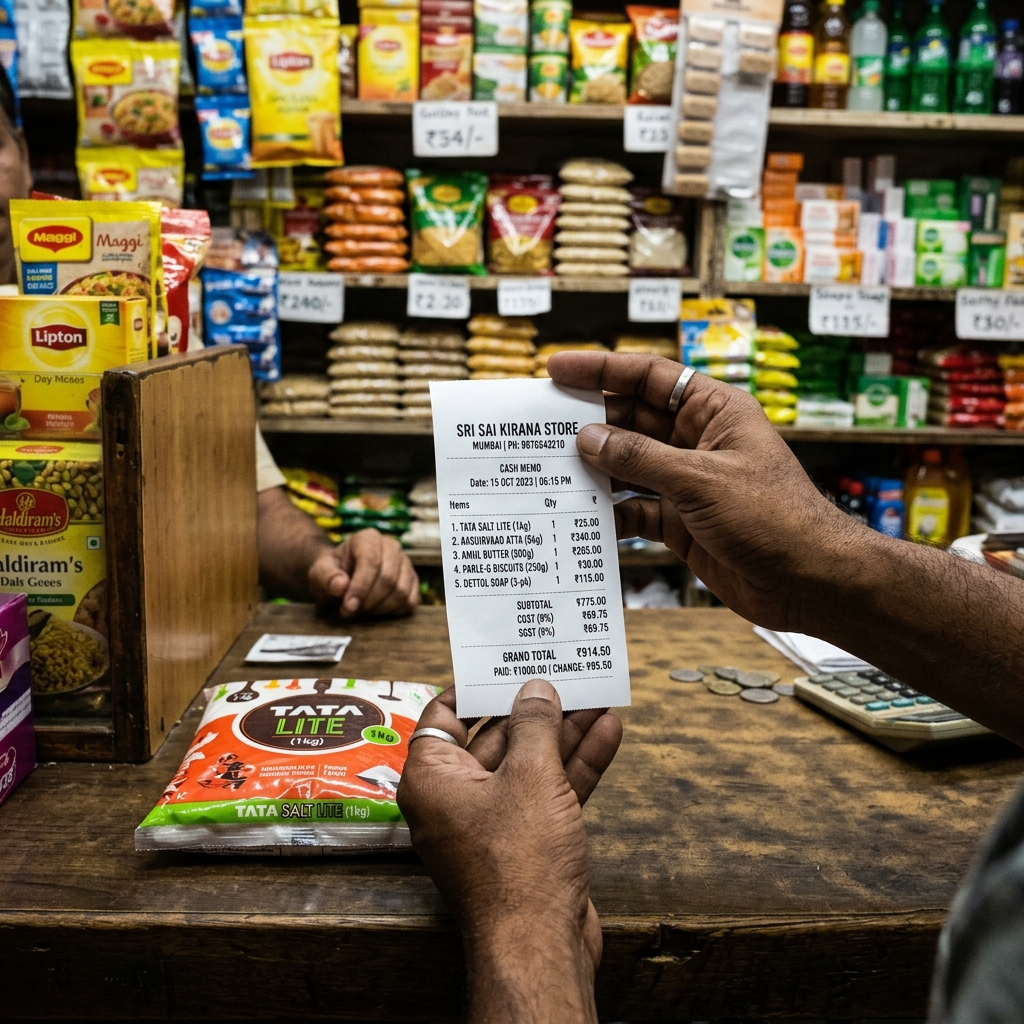
A retail shop or mart bill in India must show your shop name, address and GSTIN (if registered), a unique bill number and date, an itemised list of goods with quantity and rate, the GST split (CGST + SGST) on taxable items, and the final total. Get those right and the bill works for your customer, your records, and your GSTR-1 filing. This guide gives you the exact format, a filled sample, and a free way to make one in two minutes.
Quick answer: what a retail bill must include
- Shop / mart name, address, and contact number
- GSTIN (15 digits) if you are GST-registered
- Unique, sequential bill number and date
- Itemised goods list with quantity, unit and rate
- Optional barcode / HSN against each item
- GST rate per item, then CGST + SGST totals
- Grand total, rounding, and payment mode
Mandatory fields (and why each one matters)
| Field | Example | Why it matters |
|---|---|---|
| Shop name & logo | Lakshmi Narayan Super Mart | Brand identity; required on a tax invoice |
| Address | 22 Station Road, Chennai, Tamil Nadu 600002 | Establishes place of supply for GST |
| GSTIN | 33AABCT5567M1Z9 | Mandatory for registered shops; lets B2B buyers claim ITC |
| Bill number | RT-2026-01842 | Must be unique and sequential for GSTR-1 |
| Date & time | 01 Jun 2026, 7:18 PM | Required for the correct tax period |
| Item, qty, unit, rate | Aashirvaad Atta 5 kg × 1 @ ₹275 | Transparency; basis for tax calculation |
| HSN / barcode | 1101 / 8901234567890 | Identifies the goods and the correct GST rate |
| GST per item | 0% / 5% / 12% / 18% | Different goods fall in different slabs |
| CGST & SGST totals | 2.5% + 2.5% (per slab) | The legally required split for intra-state supply |
| Grand total | ₹550.00 | The amount actually payable |
| Payment mode | UPI / Card / Cash | Record-keeping and reconciliation |
Sample retail / mart bill (filled example)
Lakshmi Narayan Super Mart 22 Station Road, Chennai, Tamil Nadu 600002 · GSTIN: 33AABCT5567M1Z9 Bill: RT-2026-01842 · Date: 01 Jun 2026 · Cashier: Murugan
| Item | Qty | Rate (₹) | GST | Amount (₹) |
|---|---|---|---|---|
| Aashirvaad Atta 5 kg | 1 | 275.00 | 0% | 275.00 |
| Tata Salt 1 kg | 2 | 28.00 | 5% | 56.00 |
| Parle-G Biscuits | 5 | 10.00 | 18% | 50.00 |
| Colgate Toothpaste 200g | 1 | 99.00 | 18% | 99.00 |
| Fresh Tomatoes 1 kg | 1 | 40.00 | 0% (exempt) | 40.00 |
| Taxable value | 205.00 | |||
| Exempt value | 315.00 | |||
| CGST | 14.81 | |||
| SGST | 14.81 | |||
| Round off | +0.38 | |||
| Grand Total | 550.00 |
Payment: UPI · Items once sold are exchangeable within 7 days with bill. Thank you!
Note: GST is charged only on the ₹205 taxable value (salt at 5%, biscuits and toothpaste at 18%), not on the ₹315 of exempt goods (atta and vegetables). Showing the rate against each line keeps this transparent.
Retail GST: rates, registration and bill type (FY 2025–26)
Where retail bills go wrong is the per-item GST rate — a mart sells goods across several slabs at once.
- 0% (exempt / nil-rated) — fresh vegetables and fruit, unbranded atta, milk, and other unpackaged staples.
- 5% — packaged food staples such as branded flour packs, edible oil, and tea.
- 12% / 18% — most processed foods, toiletries, and household goods; 18% covers items like aerated drinks, cosmetics, and many packaged snacks.
- CGST + SGST apply when the customer is in your state (the normal case for a walk-in shop). IGST applies only for inter-state supply.
The same itemised-goods layout works for any over-the-counter shop — if you also stock office supplies, the stationery bill format follows the identical pattern, and any general-purpose retail slip can be built the same way you'd make a bill in PDF.
Each rate maps to the item's HSN code and the rate notified by the GST Council. Confirm the current rate per item from the CBIC GST rate notifications(opens in new tab) — they can change at a GST Council meeting(opens in new tab). For a deeper walk-through of the tax split, see how to calculate GST on your bill.
Do you even need to charge GST? Under the CGST Act(opens in new tab), GST registration is mandatory once turnover crosses ₹40 lakh for a goods supplier (₹20 lakh in special-category states). Below that threshold you can stay unregistered and issue a plain bill of supply — see how to create a bill for an unregistered business. Some shops opt for the composition scheme: they pay a small flat rate on turnover but cannot charge GST on the bill and must instead print "composition taxable person, not eligible to collect tax." For the full set of fields a registered shop needs, use the GST bill mandatory-fields checklist.
Honesty matters. A retail bill is a record of an actual sale. Keeping clean, sequential bills is good business — but printing a GSTIN you don't hold, or fabricating bills for goods you never sold, is invoice fraud under the GST law. Bill what you sell.
How to create a retail shop bill in 2 minutes
You do not need a POS machine for a single bill. Using the retail bill generator:
- Pick a retail / mart template that already lays out the item and GST columns.
- Enter your shop details — name, address, and GSTIN (saved for next time).
- Add goods with quantity, unit and rate; set the GST rate per item and the tool computes CGST + SGST automatically.
- Add barcode or HSN if you track them, and set the payment mode.
- Download a clean PDF ready to print on a thermal slip or send on WhatsApp.
Online generator vs Word vs Excel
| Online generator | MS Word | Excel | |
|---|---|---|---|
| Per-item slab (0/5/12/18%) | Yes Set per line | No Hand-typed | Partial Lookup formula |
| Taxable + exempt on one slip | Yes Auto-separated | Partial Manual split | Partial Needs IF formula |
| HSN / barcode column | Yes Built in | Partial Add by hand | Partial Add by hand |
| Thermal-slip / WhatsApp-ready layout | Yes One tap | No Reformat needed | No Not designed for it |
| Sequential bill numbering | Yes Auto-increments | No You track it | Partial Manual fill-down |
| Composition-scheme footer note | Yes Toggle on | Partial Retype each time | Partial Retype each time |
| Round-off + payment mode | Yes Handled | No Manual | Partial Extra cells |
Common mistakes to avoid
- Applying one flat GST rate to every item — atta and a soft drink are not in the same slab.
- Charging GST on exempt goods like fresh produce or unbranded staples.
- Charging GST at all while on the composition scheme — you cannot collect tax from customers.
- Printing a GSTIN you don't hold or an old/invalid one — this is non-compliant and blocks any B2B buyer's ITC.
- Repeating or skipping bill numbers — it breaks your GSTR-1 trail.
- Forgetting round-off and payment mode, which cause reconciliation mismatches at day-end.
Sources & references
- CBIC GST Portal(opens in new tab) — official GST rates, HSN, and tax invoice rules
- GST Council(opens in new tab) — rate change notifications
- India Code(opens in new tab) — CGST Act, registration thresholds and composition scheme
- Income Tax Department(opens in new tab) — business record-keeping requirements
Ready to ring up a clean bill right now? Create a retail shop bill free → — no sign-up, instant PDF.