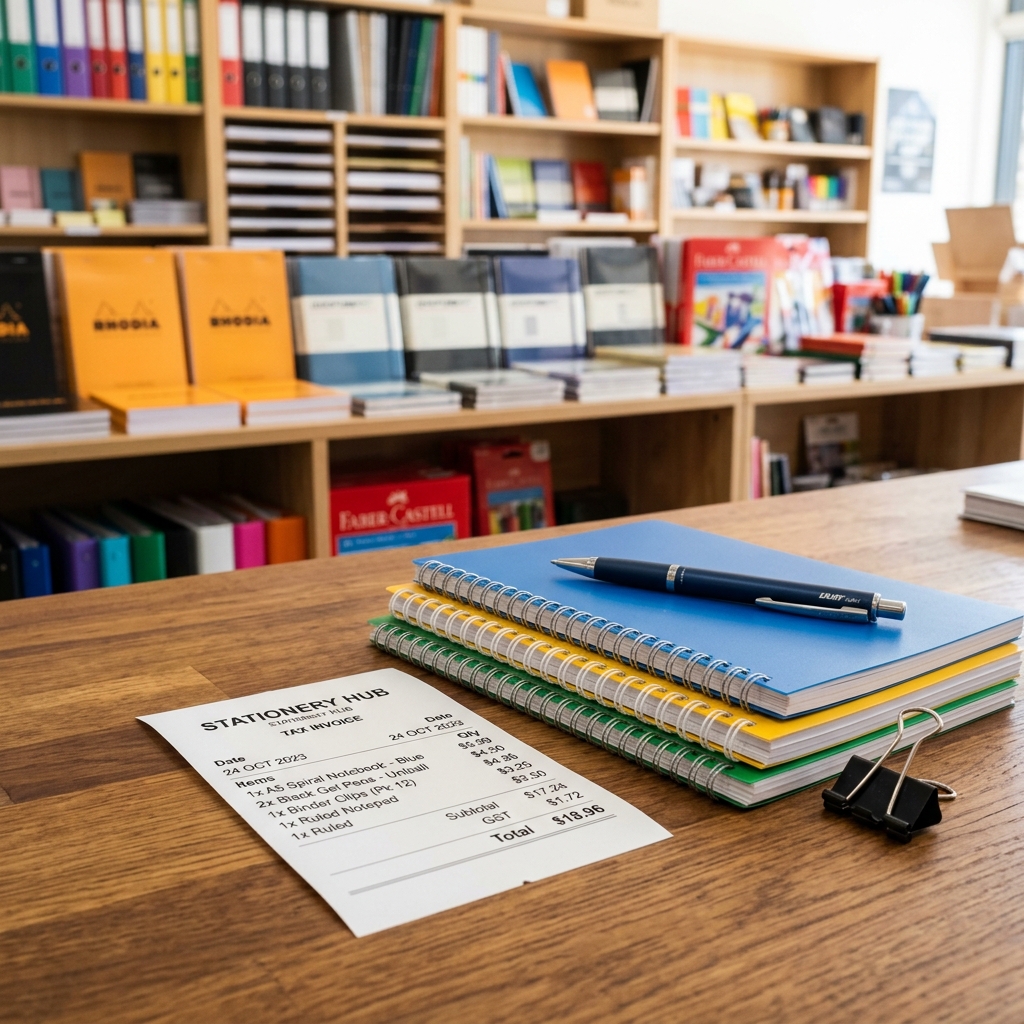
A stationery bill in India must show the shop name, address and GSTIN, an itemised list of supplies with quantity and rate, the HSN code and GST rate per item, the CGST + SGST split, and the final total. Because stationery items sit in different GST slabs, each line may carry a different rate. This guide gives you the exact format, a filled sample, and a free way to make one in two minutes.
Quick answer: what a stationery bill must include
- Shop / supplier name, address, and contact number
- GSTIN (15 digits) if the shop is GST-registered
- Unique, sequential invoice number and date
- Buyer details (name / office, GSTIN if claiming input tax credit)
- Itemised supplies with HSN code, quantity, and rate
- Per-item GST rate (0%, 12% or 18% depending on the item)
- Subtotal, CGST + SGST, and the grand total
- Payment mode (cash, UPI, card, credit)
Mandatory fields (and why each one matters)
| Field | Example | Why it matters |
|---|---|---|
| Shop name & logo | Malhotra Stationery & Xerox | Brand identity; required on a tax invoice |
| Address | 22 Lajpat Nagar, New Delhi, Delhi 110024 | Establishes place of supply for GST |
| GSTIN | 07AAECD9012K1Z8 | Mandatory for registered sellers; lets the buyer claim ITC |
| Invoice number | MS-2026-0148 | Must be unique and sequential for GSTR-1 |
| Date | 01 Jun 2026 | Required for the tax period |
| Buyer details | Priya Malhotra (office a/c), GSTIN 07AACCA1234F1Z2 | Needed for a B2B sale and ITC claim |
| Item, HSN, qty, rate | A4 Paper (HSN 4802) × 5 @ ₹320 | Transparency; basis for tax calculation |
| GST rate per item | 12% / 18% / 0% | Stationery spans multiple slabs |
| CGST & SGST | 6% + 6% (on a 12% item) | The legally required tax split for intra-state supply |
| Grand total | ₹3,074.40 | The amount actually payable |
| Payment mode | UPI / Cash / Credit | Record-keeping and reconciliation |
Sample stationery bill (filled example)
Malhotra Stationery & Xerox 22 Lajpat Nagar, New Delhi, Delhi 110024 · GSTIN: 07AAECD9012K1Z8 Invoice: MS-2026-0148 · Date: 01 Jun 2026 Buyer: Priya Malhotra (office a/c) · GSTIN: 07AACCA1234F1Z2
| Item | HSN | Qty | Rate (₹) | GST % | Amount (₹) |
|---|---|---|---|---|---|
| A4 Copier Paper (ream) | 4802 | 5 | 320.00 | 12% | 1,600.00 |
| Spiral Notebooks (180 pg) | 4820 | 10 | 65.00 | 12% | 650.00 |
| Ball-point Pens (box of 10) | 9608 | 3 | 90.00 | 18% | 270.00 |
| Printer Toner Cartridge | 8443 | 1 | 1,250.00 | 18% | 1,250.00 |
| Subtotal | 3,770.00 |
| Tax summary | Taxable value (₹) | CGST (₹) | SGST (₹) |
|---|---|---|---|
| 12% items | 2,250.00 | 135.00 | 135.00 |
| 18% items | 1,520.00 | 136.80 | 136.80 |
| Total tax | 271.80 | 271.80 |
Grand Total: ₹4,313.60 · Payment: UPI · Goods once sold are not returnable.
Notice that the bill groups tax by slab. Because a 12% notebook and an 18% cartridge sit on the same invoice, the CGST and SGST are calculated per slab, not on a single blended rate. If you would rather not do this by hand, the stationery bill generator splits the tax for you automatically. For a deeper walk-through of the maths, see our guide on how to calculate GST on your bill.
GST rates on stationery (FY 2025–26)
Stationery is one of the few categories where a single shop sells items across three different GST slabs. Getting the per-item rate right is the most common point of failure:
- 0% (nil-rated) — printed books, newspapers, periodicals, slate pencils and chalk sticks, and certain children's drawing/colouring books.
- 12% GST (6% CGST + 6% SGST) — exercise books, notebooks, graph and laboratory note books, and most paper-based stationery such as envelopes and registers.
- 18% GST (9% CGST + 9% SGST) — pens and pen sets, files and folders, staplers, calculators, printers, ink and toner cartridges, and most plastic or metal office supplies.
Because the slabs differ by item, you cannot apply one flat rate to the whole bill. List each item with its own HSN code and rate. Intra-state sales (buyer in the same state as the shop) carry CGST + SGST; an inter-state sale carries IGST instead — relevant if you supply offices in another state.
Registered vs unregistered. A shop must register for GST once its goods turnover crosses ₹40 lakh (₹20 lakh in special-category states). Below that, the shop can issue a simple bill of supply or cash memo without charging GST — see how to bill as an unregistered business for the correct format.
GST rates and HSN classifications above follow the official CBIC GST rate notifications(opens in new tab). Rates can change at GST Council(opens in new tab) meetings, so confirm the current slab for any item before you print. For the full list of fields a compliant invoice must carry, see what a GST bill must include.
How to create a stationery bill in 2 minutes
You do not need accounting software for a single bill. Using the stationery bill generator:
- Pick the stationery template that already lays out HSN and per-item GST fields.
- Enter your shop details — name, address, and GSTIN (saved for next time).
- Add each supply with its HSN code, quantity, rate and GST rate; the tool groups CGST + SGST by slab automatically.
- Add the buyer's GSTIN if it is a B2B office sale that needs input tax credit.
- Download a clean PDF ready to print, hand over, or send on WhatsApp.
This is the same approach used across retail — if you also run a general counter, the mart or retail shop bill format covers mixed-goods billing.
Online generator vs Word vs Excel
| Stationery billing need | Online generator | MS Word | Excel |
|---|---|---|---|
| Per-item HSN lookup (4802 / 4820 / 9608) | Yes Built into the line | No Type it yourself | Partial Manual reference |
| Mixed 0% / 12% / 18% slabs on one bill | Yes Tagged per line | No Easy to mis-slab | Partial Needs nested formulas |
| Tax grouped per slab (not blended) | Yes Auto-summarised | No Hand-totalled | Partial Pivot/SUMIF setup |
| Bill of supply when below ₹40 lakh | Yes One-click switch | Partial Separate template | Partial Separate sheet |
| Sequential invoice numbers for GSTR-1 | Yes Auto-incremented | No Tracked by memory | Partial Manual counter |
| Reprint a past bill for reorders | Yes Saved & searchable | Partial Hunt the folder | Partial Hunt the folder |
| Print-clean PDF for the counter | Yes Instant | Partial Formatting drifts | No Grid lines leak in |
Common mistakes to avoid
- Applying one flat GST rate to the whole bill — notebooks (12%) and pens (18%) must be taxed separately.
- Omitting the HSN code — registered sellers are required to print it for each item.
- Charging GST on nil-rated items like printed books — this overcharges the buyer and is incorrect.
- Printing an old or invalid GSTIN — the buyer can't claim ITC and you risk penalties.
- Repeating or skipping invoice numbers — breaks your GSTR-1 trail and complicates audits.
- Forgetting the buyer's GSTIN on a B2B office sale, which blocks the office from claiming input tax credit.
Sources & references
- CBIC GST Portal(opens in new tab) — official GST rates, HSN codes, and tax invoice rules
- GST Council(opens in new tab) — rate change notifications
- Income Tax Department(opens in new tab) — record-keeping for business expenses
- India Code(opens in new tab) — CGST Act and rules on invoicing
Ready to issue a compliant bill right now? Create a stationery bill free → — no sign-up, instant PDF.