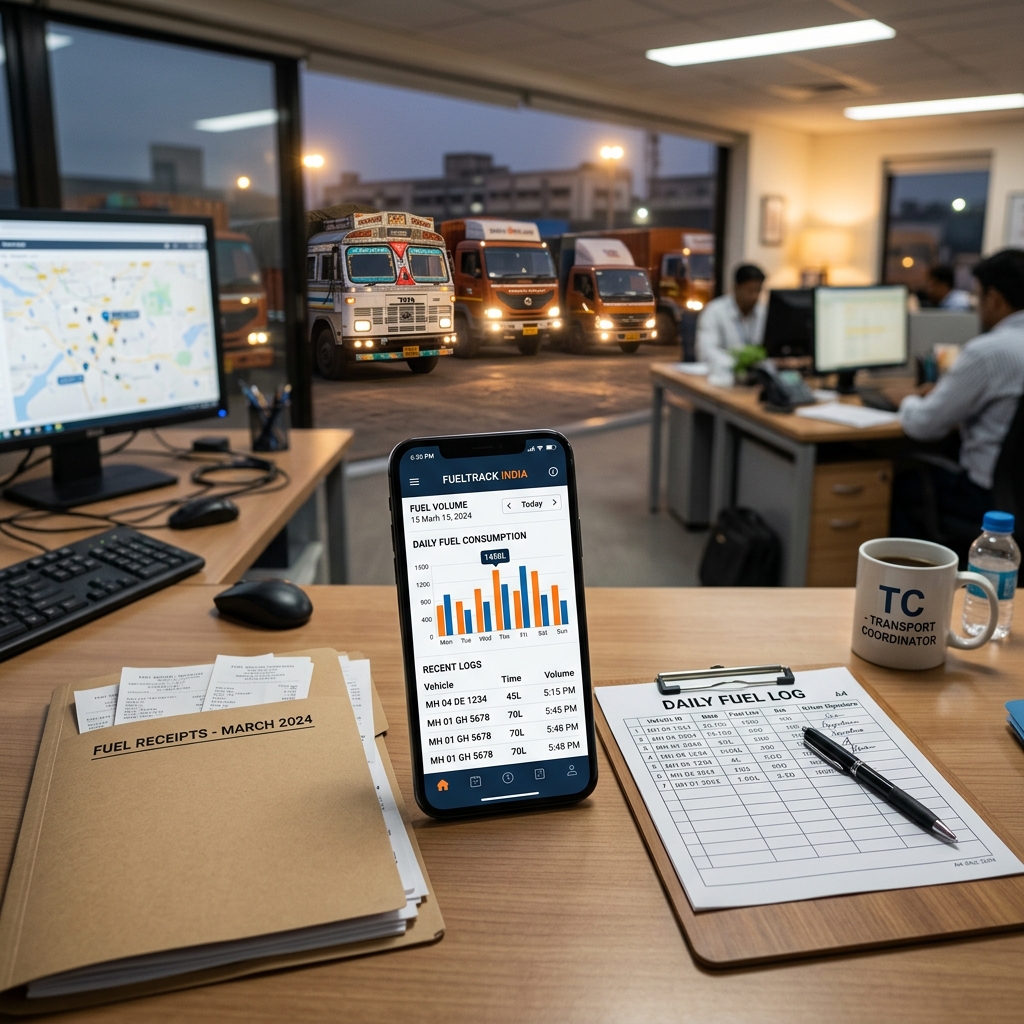
To track fleet fuel expenses, keep a dated fuel bill for every transaction, log each fill against the vehicle registration number and odometer reading, and run a monthly reconciliation that ties total litres and rupees back to each vehicle. Done well, these records control cost, surface fuel fraud, and stand up to audit. This guide gives you the fields, a sample record, and a 2-minute way to generate clean bills.
Quick answer: how to track fleet fuel expenses
- Capture a fuel bill/receipt for every transaction — no receipt, no reimbursement
- Record date, vehicle number, litres, rate per litre, amount, odometer
- Maintain a per-vehicle fuel log so each litre is attributable
- Reconcile monthly against fuel-card statements and pump receipts
- Track mileage (km per litre) per vehicle to catch leakage and fraud
- Keep the original pump receipt as the source document for audit
Mandatory fields (and why each one matters)
| Field | Example | Why it matters |
|---|---|---|
| Fuel station name & address | Lucknow Highway Fuels (IOC), Sitapur Rd, Lucknow, Uttar Pradesh | Identifies the supplier; needed for audit and tax |
| Receipt / bill number | LKO-STP-2026-08841 | Unique reference; prevents duplicate claims |
| Date & time | 01 Jun 2026, 09:14 AM | Ties the cost to a period and a trip |
| Vehicle registration number | UP32 GK 7841 | Links the litre to a specific vehicle (core of fleet tracking) |
| Fuel type | Diesel (HSD) | Different cost, mileage, and tax treatment per fuel |
| Litres dispensed | 42.50 L | Basis for cost and mileage calculation |
| Rate per litre | ₹90.80 | Lets you verify against the day's pump price |
| Total amount | ₹3,859.00 | The actual expense booked |
| Odometer reading | 84,210 km | Enables km-per-litre and detects tampering |
| Driver name / ID | Rohit Verma (D-114) | Accountability and reconciliation |
| Payment mode | Fuel card / UPI / Cash | Matches the bill to a statement line |
Sample fleet fuel record (filled example)
Lucknow Highway Fuels (Indian Oil) Sitapur Road, Aliganj, Lucknow, Uttar Pradesh 226024 · GSTIN: 09AAECL4455R1Z1 Receipt: LKO-STP-2026-08841 · Date: 01 Jun 2026, 09:14 AM Fleet account: Rohit Verma (account holder)
| Field | Value |
|---|---|
| Vehicle no. | UP32 GK 7841 |
| Driver | Rohit Verma (D-114) |
| Fuel type | Diesel (HSD) |
| Litres | 42.50 L |
| Rate / litre | ₹90.80 |
| Total | ₹3,859.00 |
| Odometer | 84,210 km |
| Payment | Fleet fuel card |
A pump receipt for petrol or diesel will not show CGST/SGST, because these fuels are outside GST (see below). For a CNG vehicle, the bill will carry GST — see how to generate a CNG bill.
Per-vehicle monthly log (how the records roll up)
| Date | Litres | Rate (₹) | Amount (₹) | Odometer | Km run | Mileage (km/L) |
|---|---|---|---|---|---|---|
| 03 May | 40.00 | 90.60 | 3,624.00 | 82,010 | — | — |
| 14 May | 41.20 | 90.70 | 3,736.84 | 82,545 | 535 | 12.99 |
| 24 May | 43.00 | 90.75 | 3,902.25 | 83,120 | 575 | 13.37 |
| 01 Jun | 42.50 | 90.80 | 3,859.00 | 84,210 | 1,090 | — |
| Total | 166.70 | — | 15,122.09 | — | — | ~13.1 avg |
A vehicle that suddenly drops from ~13 km/L to 9 km/L without a load or route change is a signal to investigate — leakage, idling, route deviation, or padded receipts.
Legal and compliance notes (FY 2025–26)
Fuel record-keeping in India sits across a few rules. Get these right and your books, reimbursements, and audits stay clean.
- Petrol, diesel, ATF and natural gas are currently outside GST. They are taxed under state VAT plus central excise, not CGST/SGST. So a genuine petrol/diesel pump receipt shows no GST split — a receipt claiming "18% GST on diesel" is a red flag. This is confirmed by the CBIC GST framework(opens in new tab) and the GST Council(opens in new tab).
- CNG, lubricants, AdBlue, and servicing do attract GST, so those bills will show CGST + SGST (or IGST inter-state). Book and claim that GST separately.
- Expense substantiation for tax. Under the Income Tax Act(opens in new tab), business expenses must be supported by genuine vouchers. Fuel logs plus original pump receipts are your primary evidence if a deduction is questioned. Retain records for the period your assessment can be reopened.
- Fuel cards and digital trails strengthen your position — the card statement is independent third-party evidence that corroborates each receipt.
Legitimate vs. fraud — be clear. Building internal fuel vouchers, logs, and reimbursement bills from genuine pump data is normal record-keeping. Fabricating a fake pump receipt to invent or inflate an expense is fraud and can attract penalties under tax and, in serious cases, the relevant provisions of the Bharatiya Nyaya Sanhita(opens in new tab). When in doubt, keep the original receipt. See what's legal when creating your own fuel bill.
How to create a fuel bill in 2 minutes
For internal records, driver reimbursements, or replacing a faded thermal receipt with a clean copy, use the fuel bill generator:
- Pick the fuel bill template — diesel, petrol, or CNG.
- Enter the station details — name, address, and GSTIN where applicable.
- Add the transaction — date, litres, rate per litre; the total computes automatically.
- Record the vehicle number, odometer, and driver so the bill is fleet-ready.
- Download a clean PDF to file, email, or attach to the reimbursement claim.
For the diesel-specific layout most fleets use, see the diesel bill format for fleet management. To turn these into a reimbursement claim, follow how to claim fuel reimbursement from your employer.
Online generator vs Word vs Excel/manual
| What fleets actually need | Online generator | MS Word | Excel / manual |
|---|---|---|---|
| Reads like a real pump receipt (station, nozzle, receipt no.) | Yes Pump-style layout | Partial Looks like a letter | No Bare grid |
| Litres × rate totals itself, no typos | Yes Auto-calculated | No You key the total | Partial Only if formula set |
| Per-vehicle fields (reg. no., odometer, driver ID) | Yes Built into the form | Partial Add by hand each time | Partial Add columns yourself |
| Omits GST on petrol/diesel correctly | Yes Fuel-aware, no tax split | No Easy to add wrong GST | No Easy to add wrong GST |
| Keeps every bill in the same fleet layout | Yes Identical across drivers | No Drifts per editor | Partial Drifts unless locked |
| Rolls up into a monthly reconciliation | Partial Export each bill | No Copy-paste pain | Yes Native in the sheet |
| Hands a driver a clean PDF to attach | Yes One-tap PDF | Partial Print-to-PDF only | No Not claim-ready |
A practical fleet setup: generate clean per-transaction bills with the tool, then roll the numbers into one Excel reconciliation sheet per vehicle for the monthly review.
Common mistakes to avoid
- No vehicle number on the bill — the litre can't be attributed, breaking per-vehicle cost and mileage tracking.
- Skipping odometer readings — without them you can't compute mileage or catch tampering.
- Accepting GST on a petrol/diesel receipt — those fuels are outside GST; a tax split signals a fabricated or wrong receipt.
- Reconciling only the total spend, not each vehicle — fraud and leakage hide inside the average.
- Discarding the original pump receipt after creating an internal copy — you lose your source evidence for audit.
- Round-figure or duplicate receipts passing unchecked — flag identical amounts, repeated bill numbers, and fills above tank capacity.
Sources & references
- CBIC GST Portal(opens in new tab) — GST framework; petrol/diesel currently outside GST
- GST Council(opens in new tab) — scope of GST and rate notifications
- Income Tax Department(opens in new tab) — expense substantiation and record retention
- India Code(opens in new tab) — statutory provisions on fraud and falsified records
Need a clean, fleet-ready fuel bill right now? Create a fuel bill free → — add the vehicle number and odometer, get an instant PDF.