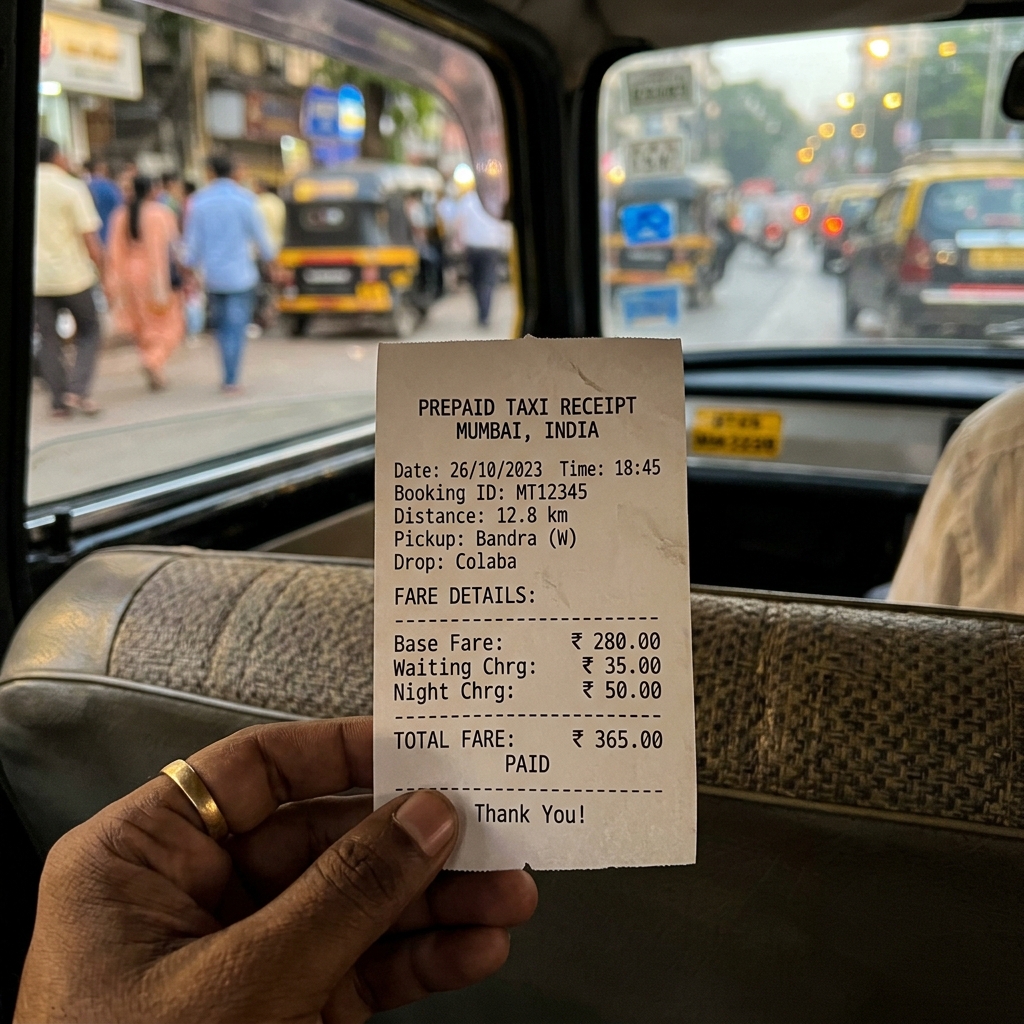
A taxi or cab bill for reimbursement must show the operator or driver details, vehicle number, date and time, pickup and drop points, distance, fare breakdown, and total. For app rides, download the auto-generated invoice — see our guide to the Uber/Ola bill for reimbursement; for cash rides where no receipt was given, create an accurate one yourself. This guide gives the exact format, a filled sample, GST rules, and a free way to make one in two minutes.
Quick answer: what a taxi bill must include
- Operator / driver name and phone number
- Vehicle registration number (e.g. CH 01 AB 4521)
- Trip date and time
- Pickup and drop locations
- Distance travelled (km) and/or trip duration
- Fare breakdown — base fare, per-km charge, waiting, tolls
- GST (5%) if a registered radio-taxi or aggregator
- Total amount and payment mode
- For company claims: employee name + purpose of travel
Mandatory fields (and why each one matters)
| Field | Example | Why it matters |
|---|---|---|
| Operator / driver name | Gurpreet Singh · Tricity Cabs | Identifies who provided the service |
| Contact number | +91 98140 33205 | Lets the finance team verify the trip |
| Vehicle number | CH 01 AB 4521 | Unique proof the ride existed; matches app records |
| Date & time | 01 Jun 2026, 9:15 AM | Establishes the travel period for the claim |
| Pickup → drop | Sector 17 Plaza → IT Park, Sector 13 | Shows the trip was work-related |
| Distance (km) | 11.4 km | Basis for the fare and for per-km policy caps |
| Fare breakdown | Base ₹50 + ₹14/km + toll ₹35 | Transparency; prevents inflated claims |
| GST @ 5% | ₹14.40 | Legally shown by registered/aggregator cabs |
| Total | ₹279.00 | The amount actually reimbursed |
| Payment mode | UPI / Cash / Card | Reconciliation and audit trail |
Sample taxi bill (filled example)
Tricity Cabs (Radio Taxi) SCO 142, Sector 17-C, Chandigarh, Chandigarh 160017 · GSTIN: 04AAMCC9012Y1Z9 Receipt: TC-2026-08842 · Date: 01 Jun 2026 · 9:15 AM Driver: Gurpreet Singh (+91 98140 33205) · Vehicle: CH 01 AB 4521
| Trip detail | Value |
|---|---|
| Pickup | Sector 17 Plaza |
| Drop | IT Park, Sector 13 Office |
| Distance | 11.4 km |
| Duration | 34 min |
| Base fare | ₹50.00 |
| Distance charge (11.4 km × ₹14) | ₹159.60 |
| Waiting charge | ₹20.00 |
| Toll | ₹35.00 |
| Subtotal | ₹264.60 |
| GST @ 5% (on cab service) | ₹14.40 |
| Total Fare | ₹279.00 |
Passenger: Anita Desai (Emp ID 4471) · Purpose: Client meeting · Payment: UPI
GST on taxis and cabs (FY 2025–26)
Where the GST goes wrong is the most common reason a claim gets queried. The key facts:
- Radio taxis and app-based cabs (Ola, Uber, Meru, BluSmart and similar) attract 5% GST on the ride, without input tax credit to the rider. For aggregator rides the tax is collected and shown on the app invoice.
- Local kaali-peeli taxis and independent auto/cab drivers below the GST registration threshold issue a plain fare receipt with no GST — that is perfectly valid for reimbursement.
- CGST + SGST apply when pickup and drop are in the same state (the usual case). IGST would apply only to an inter-state hire, which is rare for local commuting. If you ever need to split the tax yourself, our walkthrough on how to calculate GST on a bill shows the exact split.
- Petrol and diesel are outside GST, but a cab service is inside GST — so a cab bill and a fuel bill are taxed on completely different bases. Don't confuse the two.
Legitimate record vs fraud. Re-creating a receipt for a ride you actually took and paid cash for is honest record-keeping. Inventing trips, inflating distance, or duplicating one ride across multiple claims is expense fraud and a disciplinary/legal matter. Keep it accurate.
GST rates above follow the CBIC GST rate notifications(opens in new tab); aggregator liability is set out in GST Council(opens in new tab) decisions on e-commerce operators. Income-tax treatment of reimbursed travel is governed by the rules at incometax.gov.in(opens in new tab). Always confirm the current slab, as rates can change.
How to create a taxi bill in 2 minutes
For a cash ride with no printed receipt, you don't need software. Using the taxi bill generator:
- Pick the taxi/cab template — it already lays out the trip and fare fields.
- Enter operator and driver details — name, contact, and vehicle number.
- Add the trip — date, time, pickup, drop, and distance.
- Fill the fare breakdown — base, per-km, waiting, tolls; add 5% GST only if it was a registered/app cab.
- Add your name and purpose of travel for a complete reimbursement record.
- Download a clean PDF ready to attach to your expense claim.
Online generator vs Word vs Excel
| What matters for a cab receipt | Online generator | MS Word | Excel |
|---|---|---|---|
| Distance × per-km rate auto-totalled | Yes Done for you | No Add by hand | Partial Needs a formula |
| Pickup/drop and trip-time fields built in | Yes Pre-laid out | No Build from scratch | No No layout |
| Optional 5% GST line you can toggle off | Yes One click | Partial Edit manually | Partial Edit manually |
| Looks like a genuine radio-taxi slip | Yes Clean print layout | Partial Depends on you | No Spreadsheet grid |
| Sequential receipt numbers for an audit | Yes Auto-numbered | No Track yourself | Partial Manual counter |
| Toll / waiting-charge extra lines | Yes Add in a tap | Partial Reformat table | Partial Insert rows |
| Export an attachable PDF for the claim | Yes Instant | Partial Save-as PDF | No Poor PDF output |
Common mistakes to avoid
- Adding 5% GST to a kaali-peeli or independent-driver receipt that has no GSTIN — it makes the bill look fabricated.
- Leaving out the vehicle number — it's the single field auditors use to confirm a ride happened.
- Rounding distance up to inflate the fare — even a small mismatch with app data flags the claim.
- Skipping pickup/drop locations, so the trip can't be shown as work-related.
- Reusing one ride across two claims — duplicate dates and vehicle numbers are easy to catch.
- Ignoring your employer's per-trip cap (often ₹500–₹1,000) above which an official app invoice or pre-approval is required.
If your trip was part of a longer work journey, you may also need a hotel bill for travel claims or supporting LTA claim documents to complete the expense file.
Sources & references
- CBIC GST Portal(opens in new tab) — GST rates and tax invoice rules for cab services
- GST Council(opens in new tab) — aggregator/e-commerce operator GST decisions
- Income Tax Department(opens in new tab) — tax treatment of reimbursed travel expenses
Took a cab and need a receipt for your claim? Create a taxi bill free → — no sign-up, instant PDF.