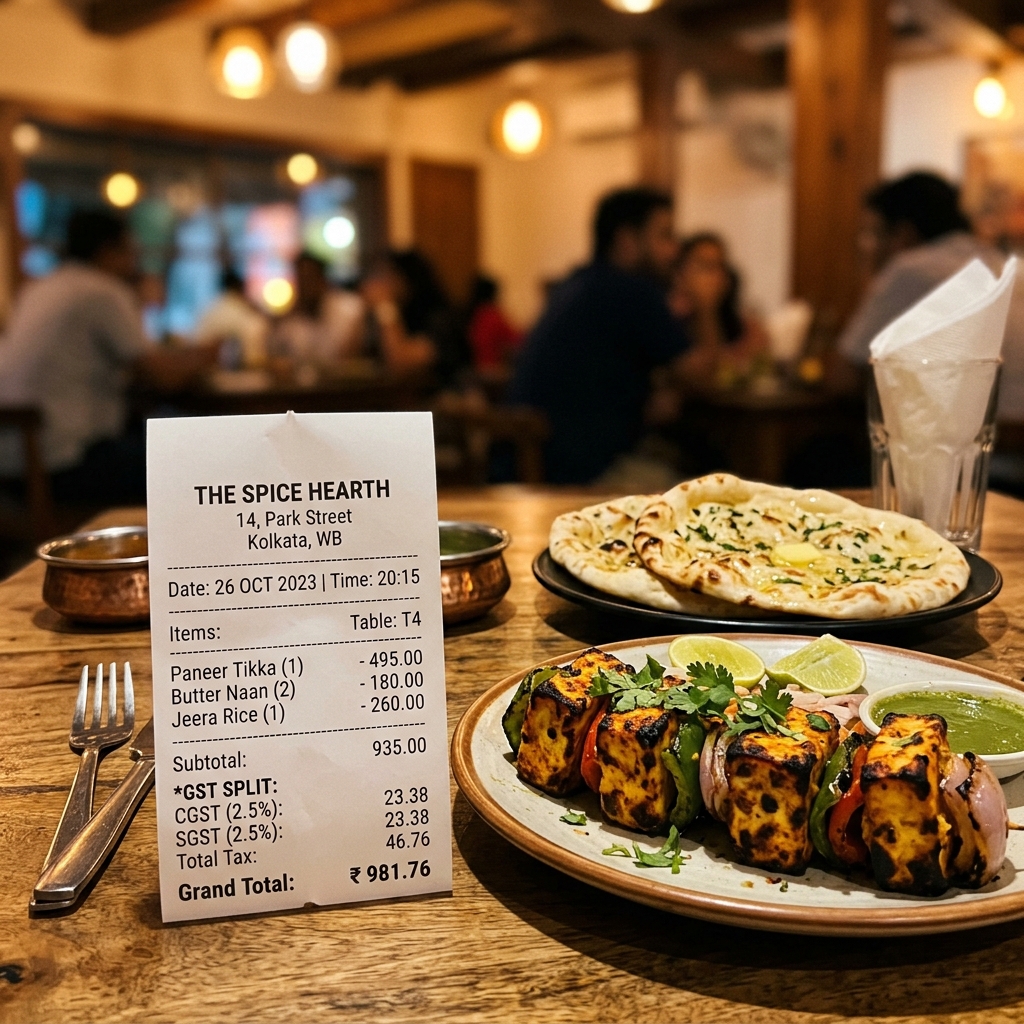
Most restaurant food in India is taxed at 5% GST (2.5% CGST + 2.5% SGST) with no input tax credit. The big exception: a restaurant inside a hotel where any room is priced above ₹7,500 a night charges 18% GST and can claim ITC. Takeaway, dine-in and app delivery all sit at 5% for a standalone restaurant. This guide breaks down every case — packaged vs prepared, ITC, and the delivery-app rule — so you bill the right slab every time.
Quick answer: GST rates on food at a glance
- 5% GST — standalone restaurants (AC or non-AC), dine-in, takeaway, and food delivered via Zomato/Swiggy. No ITC.
- 18% GST — restaurants located inside a hotel where the declared room tariff exceeds ₹7,500/night. ITC allowed.
- Delivery apps — taxed at 5%; since 1 Jan 2022 the platform (e-commerce operator) collects and pays the GST for most restaurant supplies.
- Packaged & labelled food — follows product GST rates (0% / 5% / 12% / 18%), not the restaurant rate.
- Alcohol — outside GST; taxed under state VAT/excise on a separate line.
- Outdoor catering — generally 5% (standalone) or 18% (premium-hotel catering with ITC).
The two restaurant slabs — and why they matter
Almost every restaurant in India falls into one of two GST buckets. The deciding factor is what kind of premises you operate from, not whether you have air-conditioning, a menu price level, or table service.
| Type of restaurant | GST rate | Split | Input tax credit (ITC) | Why it matters |
|---|---|---|---|---|
| Standalone restaurant (AC or non-AC) | 5% | 2.5% CGST + 2.5% SGST | No Not available | Covers the vast majority of eateries — dhabas, cafés, fine-dine standalones |
| Restaurant inside a hotel (no room above ₹7,500/night) | 5% | 2.5% CGST + 2.5% SGST | No Not available | Budget/mid-range hotel restaurants stay at the 5% slab |
| Restaurant inside a hotel (any room above ₹7,500/night) | 18% | 9% CGST + 9% SGST | Yes Available | Premium-hotel dining; the higher rate is offset by ITC on inputs |
| Outdoor catering (standalone) | 5% | 2.5% + 2.5% | No Not available | Event/party catering by non-premium operators |
| Outdoor catering (premises with room > ₹7,500) | 18% | 9% + 9% | Yes Available | Catering tied to a premium hotel |
The ₹7,500 test is about the hotel, not the meal. What matters is the declared tariff of any unit of accommodation in the premises crossing ₹7,500 per day. If even one room is priced above that, the in-house restaurant charges 18% on all food — regardless of what the diner actually paid for their room. Confirm your current classification against the CBIC GST rate notifications(opens in new tab).
The "no ITC at 5%" rule is the trade-off most owners forget. At 5%, you charge less tax but cannot recover the GST you paid on rent, raw materials, gas, equipment or commissions. At 18%, you charge more but can offset input GST. For a standalone restaurant the 5% no-ITC scheme is fixed — it is not optional. For more on the mechanics of the tax split, see our guide on how to calculate GST on a bill.
Dine-in vs takeaway vs delivery — same rate, different paperwork
A common myth is that takeaway is taxed lower than dine-in. It is not. The mode of service does not change the slab. A standalone restaurant charges 5% whether the customer eats in, takes the food away, or orders through an app.
| Service mode | GST rate (standalone restaurant) | Who collects the GST | Note |
|---|---|---|---|
| Dine-in | 5% | The restaurant | Show table number and CGST/SGST split |
| Takeaway / parcel | 5% | The restaurant | Same slab as dine-in; packaging is part of the composite supply |
| Delivery via Zomato/Swiggy | 5% | The e-commerce operator (since 1 Jan 2022) | Platform pays GST to government for most restaurant services |
| Self-delivery (your own riders) | 5% | The restaurant | You collect and pay the GST yourself |
The delivery-app change from 1 January 2022 is significant. For "restaurant service" supplied through an e-commerce operator (ECO), the platform is liable to pay the GST rather than the restaurant. You still issue a clear food bill, but the tax flow shifts to Zomato/Swiggy for those orders. Keep app and direct sales clearly separated in your records — it makes GSTR-1 filing far cleaner at month-end.
Packaged food vs prepared food — a crucial distinction
This trips up restaurants that also sell retail packs (bottled drinks, packed sweets, branded snacks).
- Prepared food served as a restaurant supply → taxed at the restaurant rate (5% / 18%). This is a service of supplying food, classified as a composite supply.
- Pre-packaged and labelled food sold as goods → taxed at the product's own GST rate under the goods schedule (0%, 5%, 12% or 18% depending on the item).
For example, a cup of masala chai brewed and served at your counter is part of your restaurant supply at 5%. A sealed branded soft-drink bottle handed over the counter is a good and carries its own product GST. Many mixed outlets (a café that also runs a small retail shelf) must therefore run two tax treatments. If your retail side grows, our mart / retail shop bill guide covers product-wise GST billing.
Watch the "pre-packaged and labelled" trigger. Since July 2022, certain pre-packaged and labelled staples (e.g. specified packed cereals, pulses, flour) attract 5% GST that loose/unbranded versions do not. If you sell such packs alongside meals, classify them under the goods rate, not the 5% restaurant rate. Verify current entries on the CBIC portal(opens in new tab).
What stays outside GST on a food bill
Not everything on a restaurant bill is a GST item. Keep these separate so your tax is calculated only on the right base:
- Alcoholic liquor for human consumption — entirely outside GST. It is taxed under state VAT/excise. Show liquor on its own line with state tax, never bundled into the 5%/18% food GST.
- Voluntary service charge — this is not a tax. Per the Department of Consumer Affairs / CCPA guidelines(opens in new tab), service charge is voluntary for the customer. If charged, show it as a separate line — never disguise it as GST.
- Tips — purely discretionary, no GST.
Mixing alcohol tax or service charge into the GST line is one of the fastest ways to issue a non-compliant bill. For the full mandatory-fields rundown, see what a GST bill must include.
Mandatory fields on a GST food bill (and why each matters)
If you are GST-registered, every food bill is a tax invoice and must carry these fields.
| Field | Example | Why it matters |
|---|---|---|
| Restaurant name & address | Arjun's Spice Kitchen, 22 Park Street, Kolkata, West Bengal 700016 | Establishes the supplier and place of supply |
| GSTIN | 19AAGCK8899T1Z7 | Legally mandatory for registered businesses; lets B2B customers claim ITC |
| Invoice number & date | INV-2026-00471 · 01 Jun 2026 | Must be unique and sequential for GSTR-1 |
| Service type | Dine-in / Takeaway / Delivery | Clarifies who bears the GST (esp. app orders) |
| Itemised food list | Paneer Butter Masala × 1 @ ₹320 | Transparency and the base for tax calculation |
| Applicable GST rate | 5% (2.5% CGST + 2.5% SGST) | The correct slab for your establishment type |
| CGST & SGST split | ₹18 + ₹18 | Required for intra-state supply (the usual case) |
| Alcohol / non-GST lines | Beer ₹200 + state tax | Kept separate from the GST food base |
| Grand total & payment mode | ₹756 · UPI | The amount payable and reconciliation record |
Annotated sample food bill (5% slab)
A realistic filled example for a standalone restaurant on the 5% slab:
Arjun's Spice Kitchen 22 Park Street, Kolkata, West Bengal 700016 · GSTIN: 19AAGCK8899T1Z7 Invoice: INV-2026-00471 · Date: 01 Jun 2026 · Table: 7 (Dine-in) · Served to: Arjun Das
| Item | Qty | Rate (₹) | Amount (₹) |
|---|---|---|---|
| Paneer Butter Masala | 1 | 320.00 | 320.00 |
| Butter Naan | 4 | 45.00 | 180.00 |
| Masala Papad | 2 | 50.00 | 100.00 |
| Sweet Lassi | 2 | 60.00 | 120.00 |
| Subtotal (taxable food) | 720.00 | ||
| CGST @ 2.5% | 18.00 | ||
| SGST @ 2.5% | 18.00 | ||
| Grand Total | 756.00 |
Payment: UPI · GST charged at 5% (no ITC) · Thank you, visit again!
For a premium-hotel restaurant the same itemised list would instead show CGST @ 9% + SGST @ 9% (18% total), and the establishment would be eligible to claim input tax credit on its purchases. Compare both layouts side by side in our restaurant bill format guide.
How GST rates on food are set (the legal basis)
GST rates on restaurant services are notified by the GST Council and published by the Central Board of Indirect Taxes and Customs (CBIC). The key reference points for FY 2025–26:
- Restaurant service rate (5% without ITC) — set under the GST rate notifications for services and confirmed across multiple GST Council(opens in new tab) meetings.
- Premium-hotel restaurant (18% with ITC) — applies where the premises has a unit of accommodation declared above ₹7,500 per day.
- E-commerce operator liability (delivery apps) — effective 1 January 2022, ECOs pay GST on notified restaurant services supplied through them.
- Registration threshold — ₹20 lakh aggregate turnover (₹10 lakh in certain special-category states) under the CGST Act(opens in new tab). Below it, issue a bill of supply rather than a tax invoice.
Rates do change. GST slabs and the conditions attached to them are revised periodically by the GST Council. Always confirm your applicable rate against the latest notification on cbic-gst.gov.in(opens in new tab) before printing new bills. Do not rely on an old rate card.
Because petrol, diesel and alcohol sit outside GST, restaurants that also run delivery fleets handle two systems — GST on food, no GST on fuel. If that applies to you, our fuel reimbursement guide explains the fuel side.
Create a correct GST food bill in 2 minutes
You do not need accounting software to issue one compliant bill. Using the restaurant bill generator:
- Pick a restaurant template with the GST fields already laid out.
- Enter your business details — name, address and GSTIN (saved for reuse).
- Select your slab — 5% (standalone) or 18% (premium hotel); the tool splits CGST + SGST automatically.
- Add menu items with quantity and rate; tax computes instantly, alcohol on its own line.
- Set service type — dine-in, takeaway or delivery — for an accurate record.
- Download a clean PDF ready to print or send on WhatsApp.
Online generator vs Word vs Excel
| Online generator | MS Word | Excel / manual | |
|---|---|---|---|
| Picks the right slab (5% vs 18%) | Yes Preset by establishment type | Partial You decide each time | Partial You decide each time |
| Auto CGST + SGST split on every line | Yes Instant | No Typed by hand | Partial Needs a formula |
| Keeps alcohol on a separate non-GST line | Yes Built in | No Easy to forget | Partial Manual layout |
| Tags service mode (dine-in / takeaway / app) | Yes Dropdown | No Free text | Partial Free text |
| Sequential invoice numbers for GSTR-1 | Yes Auto-incremented | No Risk of gaps | Partial Manual tracking |
| Per-item menu rows that re-total cleanly | Yes Live recalculation | Partial Re-type totals | Partial Formula upkeep |
| Print-ready PDF to share on WhatsApp | Yes One click | Partial Export needed | Partial Export needed |
Common mistakes to avoid
- Charging 18% when you are on the 5% slab (or vice-versa) — the establishment type decides the rate, not the air-conditioning or menu price.
- Claiming ITC while charging 5% — input tax credit is barred at the 5% restaurant rate; only the 18% premium-hotel slab allows it.
- Taxing takeaway differently from dine-in — both attract the same rate.
- Bundling alcohol into the GST line — liquor is outside GST and must carry separate state tax.
- Disguising service charge as GST — it is voluntary and must be a clearly labelled separate line.
- Applying the 5% restaurant rate to pre-packaged labelled goods — those follow product GST rates, not the restaurant rate.
- Double-charging GST on delivery-app orders — for ECO-collected supplies, the platform pays the GST; reflect this correctly in your records.
Sources & references
- CBIC GST Portal(opens in new tab) — official GST rates, restaurant service notifications and tax invoice rules
- GST Council(opens in new tab) — rate decisions and rate-change notifications
- India Code — CGST Act(opens in new tab) — registration thresholds and statutory basis
- Department of Consumer Affairs (CCPA)(opens in new tab) — service charge guidelines
Know your slab? Create a restaurant bill free → — pick 5% or 18%, get an instant GST-compliant PDF.