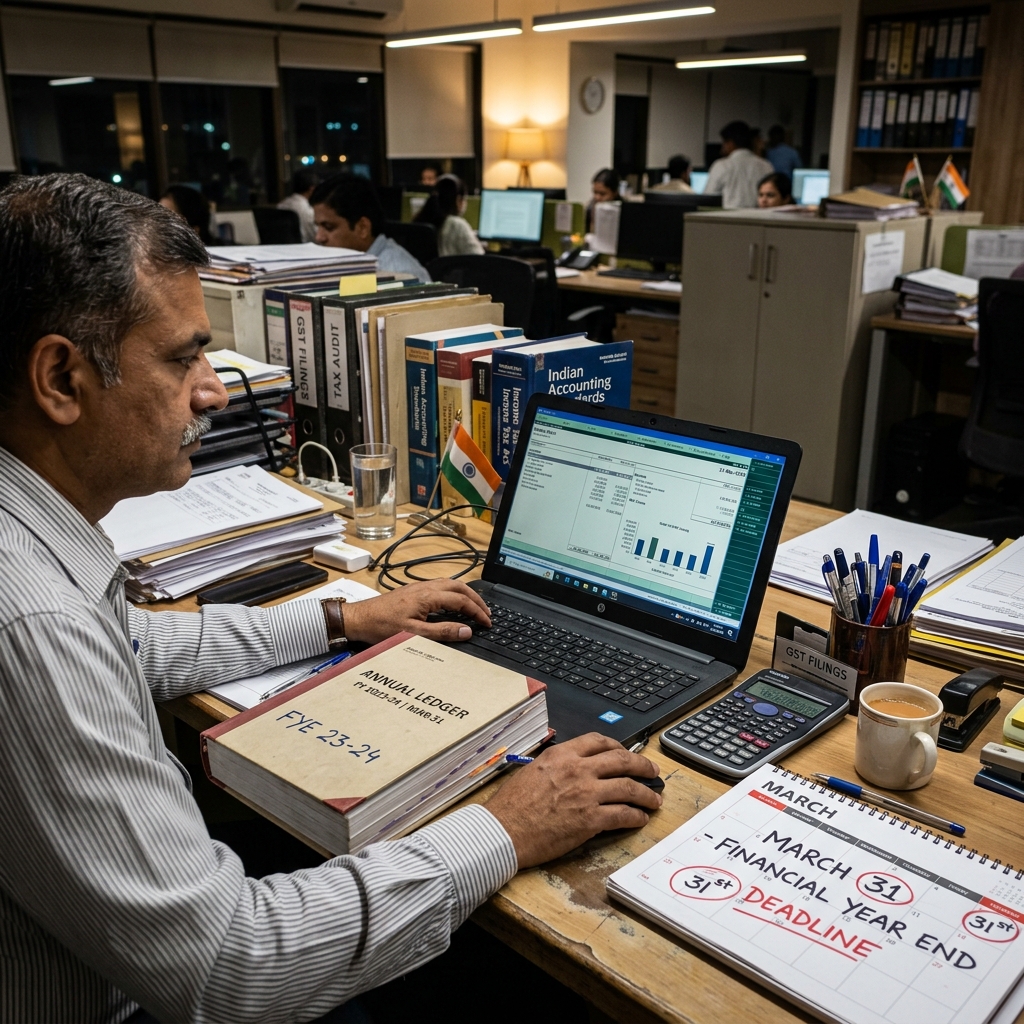
To close your books correctly at financial year end in India, invoice all delivered work, reconcile your sales against your bank and GST returns, fix any gaps in invoice numbering, and download a PDF copy of every bill. Do these before 31 March and your GSTR-1, GSTR-3B and ITR filings become a quick cross-check instead of a year-end scramble. This guide walks through each task in order.
Quick answer: your year-end billing to-do list
- Raise every pending invoice for work delivered up to 31 March
- Reconcile invoiced sales against bank credits and GST returns
- Check invoice numbering — no gaps, no duplicates, one clean series
- Collect missing GSTINs from B2B customers so they can claim ITC
- Match input bills (purchases/expenses) for the year
- Download and back up PDF copies of all bills
- Plan a fresh invoice series (e.g.
INV-2026-27-0001) for 1 April
Year-end billing tasks (and why each one matters)
| Task | What to do | Why it matters |
|---|---|---|
| Invoice pending work | Bill everything delivered by 31 March | Revenue lands in the correct financial year for ITR |
| Reconcile sales | Match invoices to bank + GSTR-1 | Catches missed or duplicated bills before filing |
| Fix invoice numbering | Ensure unique, sequential, gap-free series | A broken series triggers GST scrutiny and notices |
| Collect GSTINs | Verify 15-digit GSTIN on every B2B bill | Lets customers claim input tax credit (ITC) |
| Match input bills | Tally purchase/expense invoices | Supports ITC claims and expense deductions |
| Archive PDFs | Save every bill for 6 years | Legally required record retention under GST |
| Reset numbering | Start a new series on 1 April | Keeps each FY's invoices cleanly separated |
Reconciliation: a worked year-end example
Reconciling means making three numbers agree — your invoice register, your bank statement, and your GSTR-1. Here is a simplified March close for a small Lucknow consultancy run by Rohit Verma.
Verma Digital Services 14 Hazratganj, Lucknow, Uttar Pradesh 226001 · GSTIN: 09AAECL4455R1Z1 Proprietor: Rohit Verma · Reconciliation period: 01 Mar 2026 – 31 Mar 2026
| Invoice no. | Date | Customer | Taxable (₹) | GST 18% (₹) | Total (₹) | Status |
|---|---|---|---|---|---|---|
| INV-2025-26-0188 | 04 Mar 2026 | Bharat Petroleum Corp Ltd | 50,000.00 | 9,000.00 | 59,000.00 | Paid |
| INV-2025-26-0189 | 12 Mar 2026 | Indian Oil Corporation | 75,000.00 | 13,500.00 | 88,500.00 | Paid |
| INV-2025-26-0190 | 21 Mar 2026 | Patel Textiles Pvt Ltd | 30,000.00 | 5,400.00 | 35,400.00 | Unpaid |
| INV-2025-26-0191 | 29 Mar 2026 | Anjali Mehta (B2C) | 12,000.00 | 2,160.00 | 14,160.00 | Paid |
| Total | 1,67,000.00 | 30,060.00 | 1,97,060.00 |
The taxable total (₹1,67,000) and GST (₹30,060) here must equal the outward-supply figures you report in GSTR-1 for March — our walkthrough on preparing your bills for GSTR-1 filing shows how to make those numbers line up. Invoice 0190 is unpaid — it still belongs to FY 2025–26 because the supply happened in March, so it must be invoiced and reported now even though the cash arrives later. Gaps in the number sequence (a missing 0190, for example) are the single most common red flag in a GST audit.
Legal and compliance notes (FY 2025–26)
The Indian financial year runs 1 April to 31 March, so FY 2025–26 closes on 31 March 2026 (assessment year AY 2026–27 for income tax). Key year-end rules to respect:
- Unique invoice series per FY. Rule 46 of the CGST Rules requires a tax invoice to carry a consecutive serial number, unique for a financial year. Most businesses reset the series on 1 April. See the CBIC GST portal(opens in new tab).
- Record retention. Keep invoices and related records for at least 72 months (6 years) from the due date of the annual return, per Section 36 of the CGST Act on the India Code(opens in new tab).
- GST registration threshold. Registration is generally required once aggregate turnover crosses ₹40 lakh for goods or ₹20 lakh for services (₹20 lakh / ₹10 lakh in special-category states). Confirm your status before the new year on cbic-gst.gov.in(opens in new tab).
- GSTR-1 vs annual return. GSTR-1 (outward supplies) is filed monthly or quarterly; the annual return GSTR-9 consolidates the year. Reconcile both against your invoice register via the GST Council(opens in new tab).
- Income tax. Revenue is recognised in the year the service or sale occurred, not when payment arrives. File your ITR for the income earned in FY 2025–26 through the Income Tax portal(opens in new tab).
Honesty matters. Closing your books means recording what actually happened. Back-dating a 1 April invoice to 31 March, or fabricating a bill to shift revenue between years, is tax misreporting — not record-keeping. Issue every invoice with its true date. Legitimate reconciliation simply finds and fixes what you already earned.
Note: Petrol and diesel sit outside GST today, so fuel bills carry state VAT rather than CGST/SGST and never enter your GST input reconciliation. They remain valid for fuel reimbursement and income-tax expense records.
Close your year-end bills in 2 minutes
For any pending invoice you still need to raise, you do not need accounting software. Using the bill & receipt templates:
- Pick the right template — tax invoice, proforma, or receipt — already laid out with GST fields.
- Enter your business details — name, address, and GSTIN (saved for reuse).
- Continue your invoice series — use the next number in sequence so March stays gap-free.
- Add line items with quantity and rate; CGST + SGST compute automatically.
- Download a clean PDF and file it with the rest of your year-end records.
If you bill many customers, our guide on managing invoices for multiple clients keeps numbering consistent across all of them, and the GST bill mandatory-fields checklist confirms each invoice is complete before you file.
Online generator vs Word vs Excel for year-end billing
| Year-end need | Online generator | MS Word | Excel / manual |
|---|---|---|---|
| Continues last FY's invoice series gap-free | Yes Picks up the next number | No You retype it | Partial Only if a formula holds |
| Resets cleanly to a new 1-April series | Yes One-click new series | No Manual rename | Partial Manual cell edit |
| Splits CGST/SGST per line for GSTR-1 | Yes Computed automatically | No Hand-keyed | Partial Formula per row |
| Exports a register that ties to your bank | Yes Tidy export | No Copy-paste mess | Partial Needs clean-up |
| Batch-downloads PDFs for 6-year retention | Yes Bulk export | Partial One file at a time | No No PDF step |
| Flags a missing GSTIN before you file | Yes Field validation | No No checks | No No checks |
| Survives an audit trail review | Yes Consistent layout | Partial Easy to overwrite | Partial Easy to overwrite |
Common mistakes to avoid
- Leaving delivered work un-invoiced past 31 March — it pushes revenue into the wrong year and understates your income.
- Gaps or duplicates in the invoice series — the fastest way to attract a GST notice.
- Back-dating invoices to 31 March for next-year work — a compliance risk, not a shortcut.
- Skipping the GSTIN on B2B bills — your customer loses their ITC and may dispute the invoice.
- Forgetting to reconcile unpaid invoices — they still count as FY 2025–26 supplies even before payment lands. See the ITR billing checklist.
- Not backing up PDFs — you are legally required to retain bills for 6 years.
Sources & references
- CBIC GST Portal(opens in new tab) — tax invoice rules, invoice numbering, registration thresholds
- India Code(opens in new tab) — CGST Act record-retention provisions
- GST Council(opens in new tab) — GSTR-1 and annual-return guidance
- Income Tax Department(opens in new tab) — financial year, assessment year, and ITR filing
Ready to clear your pending bills before 31 March? Create a year-end bill free → — pick a template, continue your series, instant PDF.