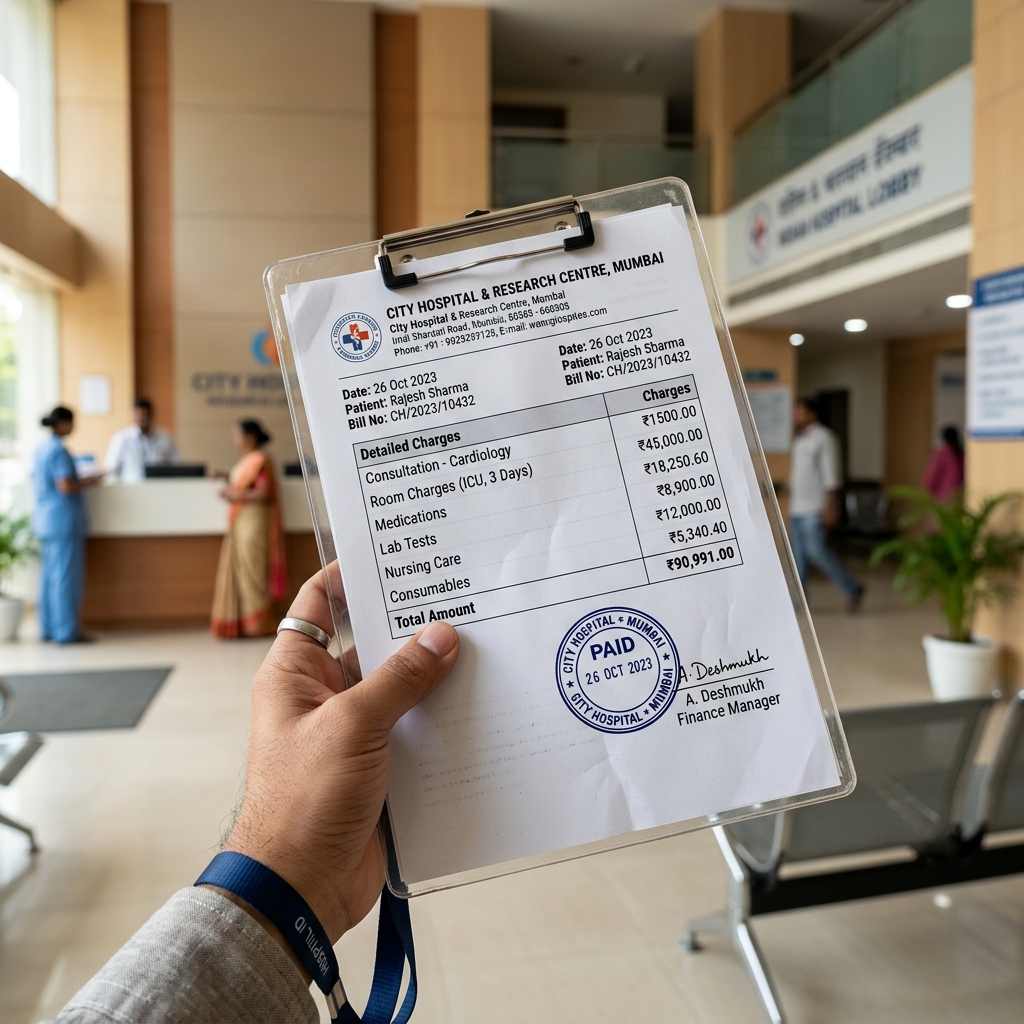
For an insurance claim, a medical bill must be an original, itemised hospital or clinic bill showing the patient's name, every charge separately (room, doctor, investigations, medicines), the hospital's GSTIN/registration details, and an official stamp and signature — backed by the discharge summary and payment receipts. Get these right and your reimbursement clears without queries. This guide gives you the exact format, a filled sample, and the rejection reasons to avoid.
Quick answer: what an insurer needs
- Patient name, age, and the treating doctor's name
- Hospital/clinic name, address, and GSTIN or registration number
- A unique, sequential bill number and date(s) of service
- An itemised charge list — never a single lump sum
- Diagnosis/procedure reference matching the discharge summary
- Subtotal, any GST shown correctly, and the final amount paid
- Official hospital stamp + authorised signature
- Supporting set: discharge summary, prescriptions, diagnostic reports, payment receipts
Mandatory fields (and why each one matters)
| Field | Example | Why it matters |
|---|---|---|
| Patient name & age | Gurpreet Singh, 47 | Must match the policy and ID proof; mismatch triggers rejection |
| Hospital/clinic name & address | Sunrise Multispeciality Hospital, Sector 34, Chandigarh 160022 | Verifies the provider is a registered clinical establishment |
| GSTIN / registration no. | 04AAMCC9012Y1Z9 | Establishes a legitimate, traceable provider |
| Bill number & date | BILL-2026-00318 · 28 May 2026 | Unique, sequential record the TPA can audit |
| Treating doctor | Dr. Harpreet Gill (Cardiology) | Links the charge to the diagnosis and prescription |
| Itemised charges | Room ₹4,000 × 3, ECG ₹600 | Lets the insurer apply sub-limits and verify each line |
| Diagnosis / procedure | Angioplasty (single stent) | Must match the discharge summary and policy cover |
| GST (where applicable) | 12% on listed consumable | Shows the correct, lawful tax — wrong tax raises queries |
| Amount paid & mode | ₹1,18,640 via Card | Proof of actual expenditure for reimbursement |
| Stamp & signature | Hospital seal + authorised sign | Without it, the bill is treated as unverified |
Sample itemised hospital bill (filled example)
Sunrise Multispeciality Hospital SCO 118, Sector 34-A, Chandigarh, Chandigarh 160022 · GSTIN: 04AAMCC9012Y1Z9 Bill No: BILL-2026-00318 · Date: 28 May 2026 Patient: Gurpreet Singh (47) · IPD No: IP-5521 · Consultant: Dr. Harpreet Gill (Cardiology)
| Particulars | Qty | Rate (₹) | Amount (₹) |
|---|---|---|---|
| Room rent (Semi-private) | 3 | 4,000.00 | 12,000.00 |
| Consultant visit | 4 | 800.00 | 3,200.00 |
| Nursing charges | 3 | 1,200.00 | 3,600.00 |
| ECG | 2 | 600.00 | 1,200.00 |
| Angiography & angioplasty (procedure) | 1 | 78,000.00 | 78,000.00 |
| Coronary stent (implant) | 1 | 14,500.00 | 14,500.00 |
| Pharmacy & consumables | — | — | 5,140.00 |
| Subtotal | 1,17,640.00 | ||
| GST on consumables @ 12% (where applicable) | 1,000.00 | ||
| Grand Total | 1,18,640.00 |
Payment: Card · Discharge summary attached · Hospital Seal & Authorised Signature: ____________
Legal & compliance notes (FY 2025–26)
Healthcare billing sits between two rulebooks — tax law and your insurer's policy wording.
- GST on healthcare. Core healthcare services provided by a clinical establishment (diagnosis, treatment, room rent within prescribed limits) are exempt from GST. But certain medicines, implants, consumables, and non-clinical services can attract GST at their own slab (commonly 5% or 12%). A bill may therefore be partly exempt and partly taxable — this is normal. Confirm each taxable line against the CBIC GST rate notifications(opens in new tab).
- GSTIN format. If the provider is GST-registered, the bill should carry a valid 15-digit GSTIN such as
04AAMCC9012Y1Z9(the04prefix is Chandigarh's state code) — if you are unsure which fields are compulsory, run the bill past the GST bill mandatory-fields checklist. A pharmacy bill is a separate tax invoice and should itemise medicines — see the base medical bill format guide for the field-by-field layout. - Originals, not copies. Reimbursement claims require original itemised bills, receipts, and reports. Submit originals to the insurer and retain photocopies. For tax records, the bill also supports your own books; see how a bill differs from a receipt when you assemble the file.
- Section 80D (income tax). Health insurance premiums qualify for deduction under Section 80D, and preventive health check-ups up to a sub-limit are allowed. Note that ordinary medical treatment bills are generally not deductible for salaried taxpayers — confirm the current limits on the Income Tax portal(opens in new tab) before filing. If you are assembling proofs at year-end, the tax-season billing checklist covers which medical documents to keep on file.
Legitimate records vs fraud. Creating a clean, itemised bill from your hospital's real charges is correct record-keeping. Fabricating a hospital bill, inflating amounts, or billing for treatment that did not happen is insurance fraud under the policy and the law — it voids the claim and can lead to prosecution. Use a generator to format genuine charges, never to invent them.
How to create an itemised medical bill in 2 minutes
For a clinic visit, day-care procedure, or pharmacy purchase you can produce a clean, claim-ready bill without software. Using the medical bill generator:
- Pick a medical/hospital template that already lays out itemised fields.
- Enter provider details — name, address, and GSTIN (saved for next time).
- Add the patient and doctor so the bill matches the discharge summary.
- List each charge separately — room, consultation, tests, medicines — with quantity and rate; the tool totals it and applies GST where you set it.
- Download a clean PDF, then add the hospital stamp and signature before submission.
This is ideal for clinics, polyclinics, and pharmacies that need professional, auditable bills; for high-value hospital admissions the hospital billing desk usually issues the final consolidated bill.
Online generator vs Word vs Excel
| What a TPA looks for | Online generator | MS Word | Excel/manual |
|---|---|---|---|
| Itemised charge layout (room, tests, pharmacy) | Yes Built-in | Partial You draw the table | Partial Build columns yourself |
| Per-line GST on taxable items only | Yes Set per row | No Hand-typed | Partial Formula per cell |
| Subtotal & grand total auto-add | Yes Always reconciles | No Re-type on edit | Yes If formulas hold |
| Room for hospital stamp & signature | Yes Dedicated block | Partial Nudge layout | No Prints awkwardly |
| Matches the discharge summary fields | Yes Patient/doctor/IPD slots | Partial Remember to add | Partial Easy to omit |
| Unique sequential bill number | Yes Auto | No Manual tracking | Partial Manual tracking |
| Claim-ready PDF the insurer accepts | Yes Clean export | Partial Export varies | No Looks like a spreadsheet |
Common mistakes to avoid
- Submitting a lump-sum or hand-written bill instead of a typed, itemised one — the single biggest rejection cause.
- Missing the discharge summary — it ties the bill to the diagnosis; insurers reject bills they cannot match to treatment.
- Sending photocopies when the insurer asked for originals (keep copies, submit originals).
- No hospital stamp or authorised signature — the bill is treated as unverified.
- Name/date mismatches between the bill, prescriptions, reports, and the policy.
- Claiming for treatment inside a waiting period or exclusion, or intimating late — read your policy wording for the exact timelines.
Sources & references
- CBIC GST Portal(opens in new tab) — GST exemptions for healthcare and rates on taxable items
- Income Tax Department(opens in new tab) — Section 80D deductions and limits
- GST Council(opens in new tab) — rate change notifications
Need a clean, itemised, claim-ready bill right now? Create a medical bill free → — no sign-up, instant PDF.